New Insights on Trademark Law
48 Issues, Seven Reform Pillars, and What Businesses Need to Know
Indoensia’s current Trademark Law (Law No. 20 of 2016) was enacted nearly a decade ago, before the explosion of e-commerce, the rise of social commerce, and the emergence of AI-generated branding. Domestically, practitioners, rights holders, and the Directorate General of Intellectual Property (DGIP) itself have encountered gaps that, if properly addressed, could improve examination consistency and enforcement effectiveness.
The Indonesian government has responded by including a comprehensive revision of the Trademark Law (RUU Merek) in the National Legislative Program (Prolegnas) for 2025–2029.
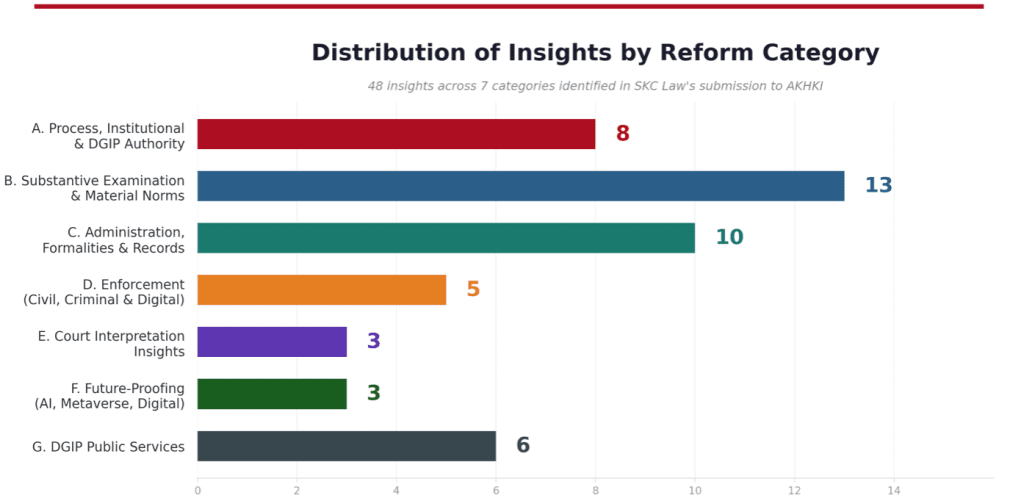
SKC Law contributed 48 recommendations across seven reform categories.
|
48 Insights |
7
Reform Categories |
4 Guiding Principles |
Four Guiding Principles
SKC Law’s recommendations are grounded in four guiding principles that the firm considers essential to the trademark system:
| Principle | Objective |
| Legal certainty and predictability | Clearer norms on well-known marks, bad faith, secondary meaning, and commercial use; enabling the DGIP and Commercial Courts to apply standards consistently |
| Examination consistency and quality | Binding examination guidelines, a Quality Management System (QMS), and written reasoning in every substantive decision |
| Efficiency and ease of doing business | Faster registration through fast-track examination, suspension mechanisms, and enforceable service-level agreements (SLAs) |
| Stronger administrative filters before litigation | Empowering the DGIP and the Trademark Appeal Commission to resolve disputes before they reach the Commercial Court |
48 Recommendations
These are not abstract concerns; they reflect problems encountered in day-to-day trademark practice in Indonesia, from examination results to the barriers in digital enforcement. The issues are organised into seven categories:
A. Process, Structure, and DGIP Authority
This targets the structural design of Indonesia’s trademark registration process.
Examination Workflow: Publish → Examine vs. Examine → Publish
Indonesia currently follows a publish-then-examine model. Applications are announced before substantive examination, which means third-party oppositions are often filed without the benefit of any preliminary screening.
Other trademark offices, including EUIPO, USPTO, and JPO, use the examine-then-publish model, where only applications that pass substantive review are published for opposition.
Recommendation(s): The reform either adopt the ‘examine-then-publish’ model or substantially strengthen examination standards before and after publication.
Fast-Track Examination
Article 23 of the current law provides only standard examination timelines. There is no legal basis for expedited examination, which means the DGIP cannot offer fast-track services without legislative change.
Recommendation(s): Explicit provisions for accelerated examination, including eligibility criteria, additional fees through official government fees / non-tax state revenue (PNBP), shortened opposition windows, and quality assurance safeguards.
Strengthening the Trademark Appeal Commission (TMAC)
The TMAC currently handles appeals against refusals but lacks broader authority. SKC Law recommends expanding the TMAC’s jurisdiction to include administrative corrections of acceptances by mistake, administrative cancellation within a defined period after registration, and mandatory publication of TMAC decisions. This would reduce the volume of disputes reaching the Commercial Court.
Other Process Reforms
The absence of legal frameworks for consent letters (co-existence agreements), examination suspension mechanisms, pre-litigation dispute resolution (mediation and ADR), binding technical examination guidelines, and examiner qualification standards is problematic. Each of these represents a gap that produces inconsistency and unpredictability in the current system.
B. Substantive Examination Standards and Material Norms
This reflects the depth of substantive gaps in the current law. Several of the most critical issues are summarised below.
Well-Known Marks: Limited Definition, Wrong Test
Article 21(1)(b) and (c) of the current Trademark Law refer to “well-known marks,” but the law provides limited definition. What’s more is the Elucidation of Article 21 applies the same similarity test (visual and phonetic) to well-known marks as to ordinary registered marks. This is a fundamental error: well-known marks require protection against dilution (blurring and tarnishment) and an association test, not the traditional similarity analysis designed for ordinary mark conflicts.
The practical consequence is that pirate marks regularly pass initial examination. Infringers who make small visual modifications to well-known marks, changing a few letters or altering a logo slightly, can avoid rejection due to the current lack of legal tools to assess broader association and dilution risks. Cases such as JOLLIBEE vs. JOLIBI, and GUCCI vs. GUCI illustrates this .
Recommendation(s): Inserting a statutory definition of well-known marks with objective indicators, separating the similarity test for well-known marks from that for ordinary marks, and adding anti-dilution provisions (blurring and tarnishment).
Proposed Separation of Similarity Tests
|
Test Type |
Applicable To | Standard |
| Visual-phonetic-conceptual similarity | Ordinary registered marks | Likelihood of confusion |
| Association test + anti-dilution (blurring & tarnishment) | Well-known marks |
Reputation and distinctiveness |
Bad Faith: Too Vague to Enforce
Article 21(3) states that applications filed in bad faith must be refused, but provides no definition, no objective indicators, and no evidentiary mechanism. Specific modern bad-faith scenarios that the current law cannot address include:
- insider hijacking by distributors or agents,
- speculative mass filing,
- proxy filing by affiliates,
- and brand squatting.
Without explicit indicators, refusal can only be on the basis of similarity, not on the basis of dishonest intent, even when the pattern of filing clearly indicates bad faith.
Recommendation(s): A statutory definition of bad faith supported by a non-exhaustive list of indicators, a shifting burden of proof (once indicators are identified, the applicant must demonstrate good faith), and DGIP authority to refuse or cancel registrations on bad-faith grounds even where no visual–phonetic similarity exists.
Other Substantive Issues
The lack of secondary meaning or acquired distinctiveness provisions, the absence of technical standards for non-traditional marks (3D, sound, hologram, position marks, colour marks, and pattern marks), undefined parameters for assessing goods and services similarity, no explicit confusing similarity test, no written opposition decisions (an estimated 60–70% of oppositions produce no written reasoning), no definition of “genuine use” for non-use cancellation purposes, gaps in licensing and sub-licensing provisions, no rules for functional marks, and no series marks mechanism.
C. Administration, Formalities, and Record-Keeping
These issues target the administrative infrastructure that supports trademark registration.
- The absence of a correction mechanism for official actions (OA),
- No partial renewal process (requiring proprietors to declare use for all goods and services even if only some are in use),
- Unpublished appeal proceedings with no digital tracking,
- Certificates that fail to specify mark type or decision basis,
- Inconsistent documentary requirements across examiners for assignment recordals,
- Goods and services descriptions changing order between filing, publication, and certificate,
- No IT governance framework for IPROLINE and PDKI systems,
- Limitations on priority claim goods and services descriptions,
- No case tracking system, and
- No digital representation standards for Madrid Protocol designations.
Each of these issues creates friction for trademark proprietors and their advisors, increases costs, and reduces predictability.
D. Enforcement: Civil, Criminal, and Digital
Arguably the most urgent gap in the current law is digital enforcement.
Digital Marketplace Protection
The current Trademark Law does not yet specifically regulate digital enforcement. It does not provide a formal notice-and-takedown mechanism, safe harbour framework, marketplace screening obligations, or a repeat-infringer policy.
In practice, platforms such as Tokopedia, Shopee, Lazada, and TikTok Shop manage takedown requests through their internal policies rather than statutory requirements, which can lead to varying approaches.
As trademark activity increasingly shifts to digital channels, estimated at around 70%, the framework presents an opportunity to further align the law with the realities of modern commerce.
Criminal Provisions for Online Sales
Article 102 of the current law criminalises trademark infringement, but it is unclear whether its scope is limited to physical trade or also includes online trade. It does not explicitly cover marketplace listings, dropship arrangements, social commerce, cross-border online selling, or digital advertising. Law enforcement agencies regularly face challenges in applying these provisions to online sellers.
Other Enforcement Opportunities
Further opportunities to strengthen the framework include clearer data protection and confidentiality standards within the DGIP, more structured coordination protocols between the DGIP, police, and prosecutors for criminal enforcement, and the development of a brand recordation system connecting the DGIP with Customs (Bea Cukai) to enhance border enforcement.
E. Court Interpretation
A number of concerns arise from judicial interpretation of the current law. These include unclear rules on premature filing and party joinder (as illustrated by the BMW vs. BYD case, where the Commercial Court dismissed a cancellation action as premature because the DGIP examination was still pending) forcing courts to choose between full cancellation and no cancellation, with no middle ground.
F. Future-Proofing: AI, Digital Economy, and the Metaverse
Emerging challenges that the current law does not anticipate include virtual goods and metaverse environments that are not recognised as objects of trademark protection. AI-generated branding raises unresolved questions about ownership and registrability. Digital franchising and platform licensing models, including multi-tier licensing through aggregators and brand operators, have no legal framework for recordal or enforcement.
G. Public Services
The current law does not yet provide obligation for DGIP to fulfil service-level agreements (SLAs) on examination or recordal timelines, publication of appeal, opposition, and cancellation decisions, providing structured open data for research and transparency, examination quality audits, security procedures for applicants affected by IT system disruptions, or standards for digital certificates and PDKI data integrity.
Indonesia vs. International Standards
A comparison of Indonesia’s current Trademark Law framework against established international practices illustrates the scope of reform required:
|
Feature |
Indonesia (Current) | International Standard |
|
Well-known mark definition |
No statutory definition or criteria | Explicit criteria (EUIPO, USPTO, WIPO Joint Recommendation) |
|
Bad faith indicators |
General clause only; no indicators | Detailed indicators and shifting burden of proof (EU, China, Japan) |
|
Confusing similarity test |
No codified parameters | Visual–phonetic–conceptual framework with dominant element analysis |
|
Non-traditional marks (technical standards) |
Recognised in definition only; no examination standards | Detailed filing and examination guidelines (EUIPO, UKIPO, JPO) |
|
Notice-and-takedown for digital platforms |
Not addressed in Trademark Law | Mandatory frameworks (EU DSA, China E-Commerce Law) |
|
Examination quality audit |
No legal requirement | QMS, peer review, quality assurance units (EUIPO, USPTO) |
|
Published examination guidelines |
No publicly available information | Publicly available, regularly updated guidelines |
|
Service-level agreements |
No legal basis | Statutory or regulatory SLAs (EUIPO, IPOS) |
|
Brand recordation (Customs) |
No interoperability system | Integrated brand recordation systems (US, China, Philippines) |
| Genuine use definition | Not defined |
Codified definition with objective parameters |
What This Means for Businesses
The proposed changes may affect enforcement strategies, renewal obligations, non-use exposure, and dispute resolution procedures. Businesses should monitor legal updates and assess how the reforms may impact operations. Where relevant, securing well-known mark status under the current framework may also be worth considering before standards evolve.
Companies are advised to maintain documentation of trademark use, particularly in anticipation of potentially stricter genuine-use requirements under a reformed non-use cancellation regime. Licensing structures should also be reviewed; especially those involving digital platforms, sub-licences, and cross-border arrangements, to ensure continued compliance as the framework develops.
In addition, enforcement should be strengthened in light of potential new digital enforcement mechanisms and brand recordation systems that may introduce additional enforcement channels. Working with IP experts will be essential to optimise trademark portfolios under both the current and anticipated legal landscape.
Preparing your trademark strategy? Contact us now.
Follow us on LinkedIn for ongoing IP updates. Submit a custom inquiry via our Contact Page.
| This content is provided for general information only and does not constitute legal advice. For advice on specific matters, contact enquiries@skclaw.id. |