New Mechanism for Reporting Online IP Infringement
Recently, the Minister of Law enacted Regulation No. 47 of 2025 on the Handling of Intellectual Property Infringement Reports in Electronic Systems (Permenkum 47/2025). Gazetted in State Gazette No. 1018 of 2025 on 5 December 2025, the regulation establishes a structured procedure for IP rights holders to report suspected online infringements to the Directorate General of Intellectual Property (DJKI) and, where violations are confirmed, to obtain recommendations for the closure of websites and the termination of access to infringing content.
This regulation addresses a gap in the current IP enforcement framework. Although civil and criminal measures were available under existing legislation, the mechanisms for tackling IP infringement through electronic systems, including e-commerce platforms, websites, applications, and social media; had not been consolidated into a dedicated procedural framework. Permenkum 47/2025 now provides that mechanism.
Scope of Protection
The regulation covers all categories of intellectual property rights recognised under Indonesian law. Article 2 identifies eight types: copyright and related rights; industrial designs; patents; layout designs of integrated circuits; trade secrets; trademarks; geographical indications; and communal intellectual property. These must be rights that have been registered or recorded with the DJKI in accordance with the current legislation.
The reporting mechanism is not limited to trademark counterfeiting or copyright piracy but extends to all forms of IP infringement conducted through electronic systems. Under Article 3, a violation is defined as any activity involving the production, sale, reproduction, or distribution of material, creations, products, services, or marks protected by intellectual property rights, without the authorisation of the rights holder; where such activity takes place through an electronic system.
Who Can File a Report
Reports may be filed by two categories of claimants: registered or recorded IP rights holders, and recorded licensees. In both cases, the underlying right or licence must be registered or recorded with the DJKI. Reports may also be submitted through an authorised representative, in accordance with applicable laws.
How to Report
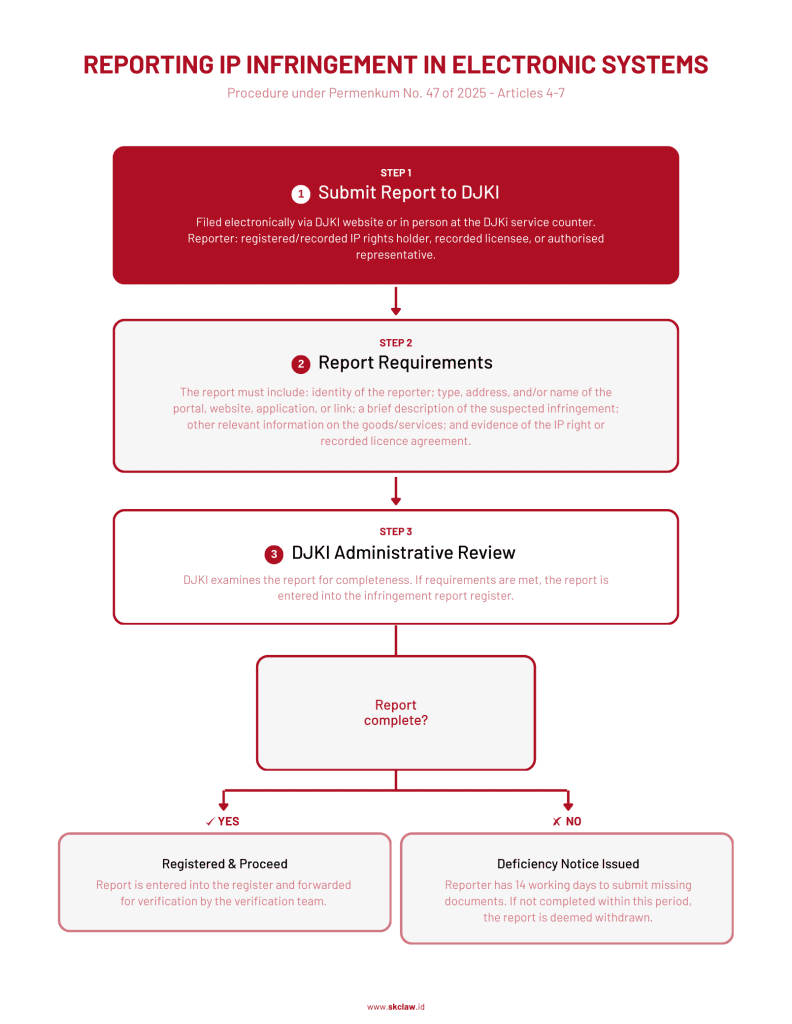
Reports can be submitted electronically through the DJKI’s official website or in person at the DJKI’s service counter. Each report must include, at a minimum, the identity of the reporter; the type, address, and/or name of the portal, website, application, or link containing the allegedly infringing content; a brief description of the suspected infringement; and other information relevant to the goods or services in question. Supporting documentation must accompany the report, specifically evidence of the IP right or a recorded licence agreement.
If a report is found to be incomplete during the administrative review, the reporter is given 14 working days from the date of the deficiency notice to provide the missing documents. Failure to do so within this period results in the report being deemed withdrawn.
Verification and Timeline
Once a report passes the administrative check and is entered into the register, a verification team is formed. This team comprises representatives from the Ministry of Law, the Ministry of Communication and Information, and relevant IP associations. The team may also include experts in intellectual property, information technology, or representatives from other government bodies. The verification process is expected to be completed within three working days from the date the report is registered.
The verification team’s responsibilities include examining the validity of the reported infringement, preparing an official verification report, assessing whether full or partial closure of the relevant site or termination of access is warranted, and formulating recommendations. The team may also request information from the Electronic System Operator / Penyelenggara Sistem Elektronik (PSE) or the party being reported.
Available Remedies
Where the verification confirms an infringement, the team may recommend one or more of three remedies: partial site closure, full site closure, or access termination. The regulation defines “access termination” (Pemutusan Akses) broadly to include blocking access, closing accounts, and/or removing content. These recommendations are directed by the Minister, through the Director General, either to the Ministry of Communication and Information or directly to the relevant Electronic System Operator. Importantly, the recommendation must be transmitted within 24 hours of being signed.
Where insufficient evidence is found and the report does not meet the threshold for an infringement, the verification team reports this outcome to the Minister, and the result is communicated to the reporter.
Expedited Process for Live Content
The regulation includes a notable provision for live or real-time infringements. Under Article 11, where the allegedly infringing content is being disseminated through a live broadcast, the entire verification and recommendation process must be completed within 24 hours. This accelerated timeline reflects the time-sensitive nature of live content, where delays in enforcement could render any action ineffective.
Reopening of Sites and Restoration of Access
Permenkum 47/2025 also establishes a pathway for Electronic System Operators or users to apply for the reopening of a closed site or the restoration of access. This may be granted where the applicant obtains cooperation or permission from the IP rights holder, or where a mediation process with the original reporter produces an agreement. Applications must be accompanied by supporting documentation, and the same administrative and verification procedures applicable to the original report apply to reopening requests.
Practical Implications
This improvement represents a step forward in Indonesia’s approach to digital IP enforcement.
For rights holders, it offers a clear channel to address online infringement without needing to initiate formal litigation. The involvement of a multi-agency verification team, rather than a unilateral decision by a single body, adds procedural diligence efficiently.
However, the effectiveness of the regulation will depend significantly on its implementation. The Director General is tasked with issuing further implementing guidelines on verification and recommendation procedures. Several practical questions remain open, including how the verification team will handle complex disputes, how Electronic System Operators will respond to recommendations in practice, and how the mediation process for reopening will be administered. These details will shape whether the regulation achieves its stated objective of providing effective and efficient protection for IP rights in the digital environment.
Rights holders and licensees with IP registrations or recorded licences at the DJKI should take note of this new mechanism and consider how it fits within their broader online enforcement strategies. Businesses operating electronic systems in Indonesia should also familiarise themselves with the regulation, given that they may receive closure or access termination recommendations as a result of verified reports.
For further information on how this regulation may affect your IP enforcement strategy in Indonesia, contact our team.
Follow us on LinkedIn for updates on IP in Indonesia. Submit a custom inquiry via our Contact Page.
This content is provided for general information only and does not constitute legal advice. For advice on specific matters, contact enquiries@skclaw.id.