A Closer Look at Trademark Regulation 5/2026
Indonesia’s Trademark Office has been processing trademark registrations at a faster pace in recent years. SKC Law has observed that applications are now registered roughly six months from filing, compared to the previous average of up to twelve months. Until recently, no formal regulation or guidance had been issued to explain the change, though the operational shift was consistent across multiple filings.
On 23 February 2026, the Minister of Law enacted Regulation No. 5 of 2026 on Trademark Registrations (“Regulation 5/2026”), replacing the previous framework under Regulation No. 67 of 2016 as amended by Regulation No. 12 of 2021. The new regulation formalises the accelerated processing timelines that had been observed in practice, introduces revised documentary requirements, and establishes the mechanism for assignment for of pending trademark applications and a new procedural force majeure-based deadline extensions.
Our blog summarises the key changes and their practical implications.
Dramatically Accelerated Processing Timelines
The headline change under Regulation 5/2026 is the compression of several administrative timelines to a fraction of their former duration.
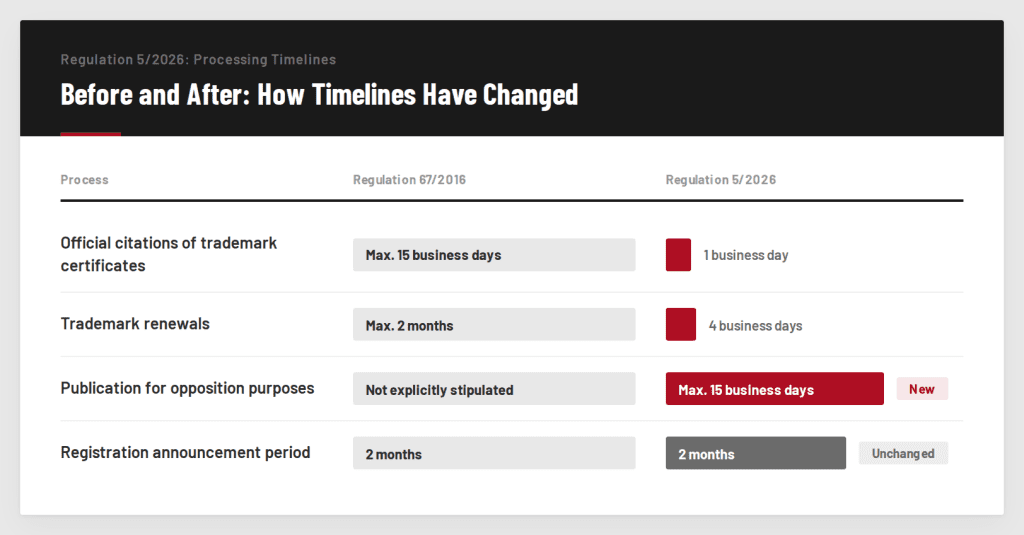
The reduction in processing timelines is significant, particularly for rights holders who need to show proof of trademark registration for enforcement or commercial purposes. In practice, the above services can even be completed faster.
Any highlighted provisions regarding accelerated processing timelines under Regulation 5/2026 are as follows:
- Expedited substantive examination period: where no opposition is filed, the substantive examination must be completed within a maximum of 30 working days. If an opposition is filed, the examination period may be extended by up to 90 working days.
- Expedited renewal process for trademark registrations: renewals are now processed within 4 working days after all required documents are completed, and the renewal notice is issued within 3 working days from the date of completion. Previously, renewals could take up to 2 months, with the notice issued within 15 working days from completion.
- Expedited issuance of official citations: official citations are now issued within 1 working day, compared to 15 working days under the previous regulation, facilitating faster recordals and other transactions requiring official trademark documents.
In particular to the expedited substantive examination period, please note that it may involve certain practical trade-offs that rights holders should be aware of. Late informal oppositions, including those directed at potential bad faith applications, may no longer be considered if first substantive examination results have already been issued.
Amended Documentary Requirements
Regulation 5/2026 streamlines the list of documents that must accompany an application for trademark registration, while adding new requirements in specific areas.
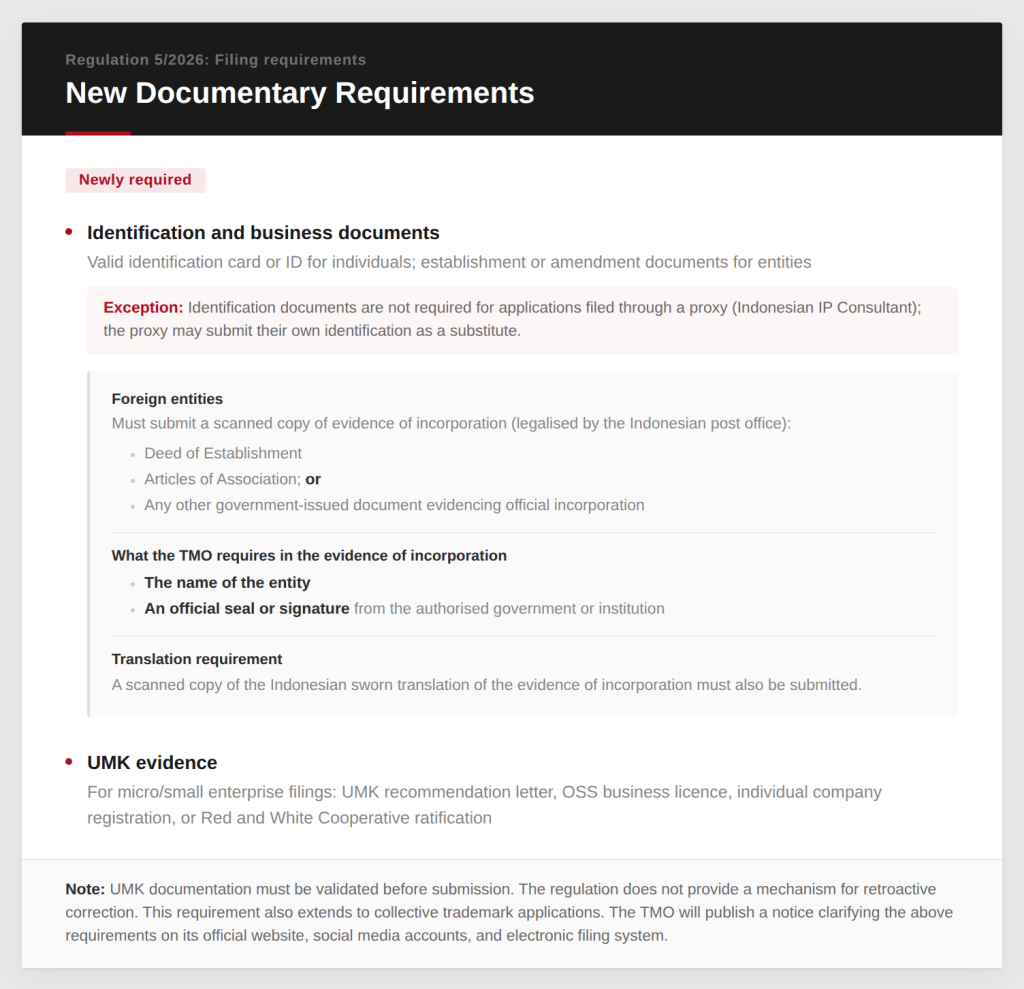
Several requirements from the previous regulation have been removed, including proof of payment of the application fee and the submission of three physical copies of the trademark label. The statement of trademark ownership, power of attorney (if a representative is appointed), proof of priority rights, and sound recordings for sound marks all remain required.
The Usaha Mikro dan Kecil / UKM (Small Micro Enterprise / SME) documentation requirement also extends to collective trademark applications. Rights holders filing under the UMK fee category should ensure that their supporting documentation is validated before submission, as the regulation does not provide a mechanism for retroactive correction.
Mechanism of Assignment of Pending Trademark Applications
The regulation also strengthens the legal basis by providing details of the transfer (assignment) of trademark applications that are still undergoing examination. Previously, this requirement only introduced briefly in the Trademark Law.
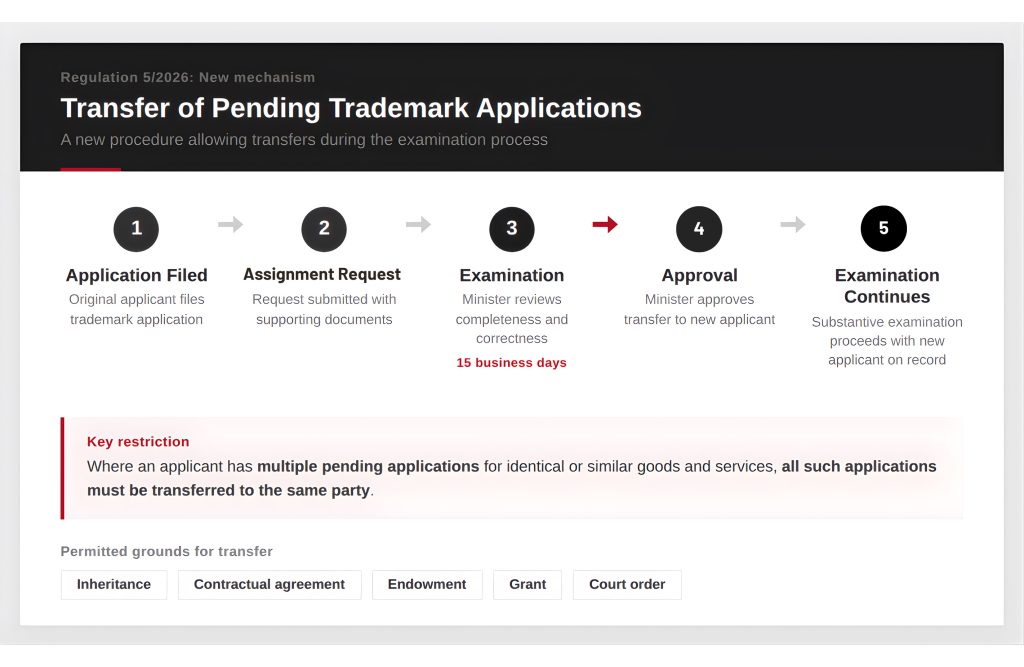
The regulation sets out five grounds for assignment, including inheritance and contractual agreement.
One consistent key restriction applies: where an applicant has multiple pending applications for similar marks and identical marks for similar goods and services, all such applications must be assigned to the same party.
This is important for rights holders undergoing corporate restructuring, mergers, or acquisitions. It allows trademark portfolios to be assigned during the registration process, eliminating the need to wait for registration to complete before aligning IP assets with the new corporate structure.
New: Force Majeure Deadline Extensions
The regulation introduces a formal mechanism for extending procedural deadlines where applicants are unable to meet their obligations due to force majeure events, defined to include natural disasters, riots, and labour strikes.
Deadline extensions may be requested across multiple stages of the registration process, including the completion of formality document deficiencies, priority rights documentation, name or address changes, assignment applications, and renewal requirements.
Applicants must submit supporting evidence of the force majeure event to the Minister. If approved, a new deadline will be issued. Failure to meet the extended deadline may result in the application being classified as withdrawn or the initial filing being deemed unprocessable.
Practical Implications for Rights Holders
Review internal filing protocols. The dramatically shortened timelines require corresponding adjustments to internal tracking and deadline management systems.
Prepare company documentation in advance. For foreign company applicants, it is advisable to prepare company documentation e.g. evidence incorporation in advance to ensure formality requirements are met.
Note the transitional provisions. Applications submitted before 23 February 2026 will continue to be processed under Regulation 67/2016 as amended by Regulation 12/2021. The new timelines and mechanisms apply only to applications filed from that date onward.
SKC Law’s Prosecution & Litigation Team advises rights holders on all aspects of trademark registration, renewal, and portfolio management in Indonesia. Contact our team to discuss how these changes affect your trademark strategy. Follow us on LinkedIn for the latest updates.
This content is provided for general information only and does not constitute legal advice. For advice on specific matters, contact enquiries@skclaw.id.