Indonesia Broadens Patent Protection and Introduces Early Substantive Examinations
On 23 February 2026, the Minister of Law enacted Regulation No. 6 of 2026 on Patent Applications (“Regulation 6/2026”), replacing the previous framework under Regulation No. 38 of 2018 as amended (“Regulation 38/2018”). The new regulation expands the categories of inventions eligible for patent protection, revises filing procedures and timelines, and introduces two new substantive examination mechanisms; early substantive examinations and re-examinations; that give applicants significantly more flexibility in how and when their applications are assessed. Our blog goes through the key changes and their practical implications for patent applicants and rights holders in Indonesia.
Expanded Scope of Patentable Inventions
A fundamental question for any innovator considering patent protection in Indonesia is: does my invention fall within the categories that Indonesian law recognises?
Under the previous framework, patent protection was available for products, processes, and improvements or developments relating to products and processes. Regulation 6/2026 retains all of these categories and adds three more: systems, methods, and utilisations.
| Form of Invention | Reg 38/2018 | Reg 6/2026 |
| Products | ✓ | ✓ |
| Processes | ✓ | ✓ |
| Improvements to products/processes | ✓ | ✓ |
| Developments of products/processes | ✓ | ✓ |
| Systems | — | ✓ |
| Methods | — | ✓ |
| Utilisations | — | ✓ |
This expansion aligns Indonesia’s patent framework with the Third Amendment to the Patent Law (Law No. 65 of 2024). For innovators working in areas such as software-enabled systems, business methods with a technical component, or novel applications of existing technologies, the inclusion of systems, methods, and utilisations creates clearer pathways to patent protection.
Revised Filing Procedures and Timelines
Regulation 6/2026 introduces several procedural changes that directly affect how patent applications are prepared and filed.
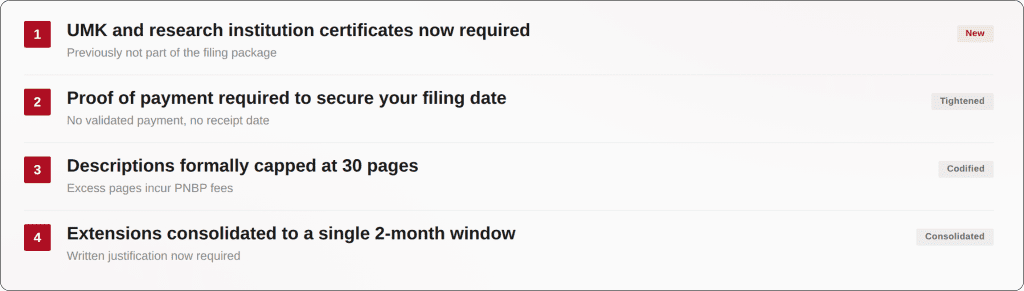
UMK and research institution documentation.
Applicants filing as micro- or small-scale enterprises (Usaha Mikro dan Kecil) or research institutions must now submit certificates confirming their status as part of the application. This was not required under the previous framework.
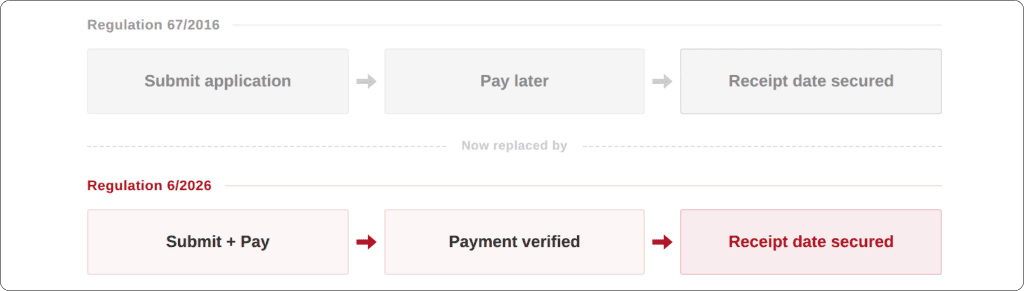
Receipt date requirements tightened.
Securing a receipt date (tanggal penerimaan); the date from which the application is formally recognised; now requires proof of payment of both the application fee and any excess claim fees (where more than 10 claims are filed). Previously, no proof of payment was explicitly required. Applicants who previously relied on fee payment being processed separately from filing will now need to ensure that payment is validated before or at the time of submission to avoid losing their filing date.
Extension periods consolidated.
Under the old framework, applicants could request an initial two-month extension for document deficiencies, followed by a further one-month extension (subject to PNBP fees). Regulation 6/2026 consolidates this into a single two-month extension, with a written justification now required.
Extension periods consolidated.
Under the old framework, applicants could request an initial two-month extension for document deficiencies, followed by a further one-month extension (subject to PNBP fees). Regulation 6/2026 consolidates this into a single two-month extension, with a written justification now required.
Amendments to required documents for filing:
- Removal of Declaration of Invention. Regulation 6/2026 removes the requirement to submit a Statement of Declaration of Invention executed by the inventor as part of the patent application formalities. This simplifies the filing process and reduces the initial documentation burden.
- Alternative documents for Assignment of Invention. Regulation 6/2026 introduces an alternative mechanism to satisfy formality requirements where the Assignment of Invention cannot be executed by the inventor. In such cases, the applicant may submit supporting documents, including:
- a letter of authorization for signing;
- evidence of employment relationship; and/or
- a statement from the applicant regarding the employment relationship with the inventor. This provides greater flexibility, particularly in employer–employee invention scenarios.
Practical Impact for Applicants
|
Priority Rights and the PCT Framework
The 12-month deadline for filing applications claiming priority rights remains unchanged. However, Regulation 6/2026 introduces a new grace period: applications may now be filed up to four months after the expiry of the 12-month deadline, subject to the payment of additional PNBP fees. This provides a safety net for applicants who narrowly miss the standard deadline.
The regulation also clarifies that PCT applications filed through Indonesia as the Receiving Office may now be submitted with or without priority rights; a distinction that was not explicitly addressed under the previous framework.
Additionally, where a Description is submitted through WIPO’s official website in Indonesian, the applicant must provide an English translation within two months of the international receipt date.
Important to note:
- Alignment of application type: the regulation now expressly requires that the type of patent application filed in Indonesia must be the same as that of the priority application in the country of origin. Applicants must therefore ensure consistency (e.g., patent vs. simple patent) at the time of filing, as any discrepancy may give rise to formal objections; and
- No patent conversion allowed for application with priority rights: the regulation further clarifies that conversion between types of patent applications is no longer permitted. Accordingly, applicants can no longer convert a patent application into a simple patent (or vice versa) after filing, underscoring the importance of selecting the appropriate type from the outset.
Reinstatement of Withdrawn Applications
Regulation 6/2026 introduces a mechanism allowing applicants to refile or reinstate patent applications that have been withdrawn. Applicants or their representatives may submit a new request for such applications, subject to the payment of applicable PNBP fees. This request must be filed within six months from the date of the notification letter confirming the withdrawal.
Early Substantive Examination Mechanism
Early substantive examination allows applicants to request a substantive examination before the publication period commences, provided that all administrative requirements have been fulfilled. A decision on approval or rejection will be issued within 12 months of the end of the publication period; or within 30 months if a third-party objection is filed. This mechanism allows applicants to accelerate the overall examination timeline, which is particularly valuable for innovations with short commercial lifecycles or where early grant is needed for enforcement or licensing purposes.
In the context of early substantive examination, the Patent Examiner may also request additional supporting documents, including search results and/or substantive examination reports issued by other patent offices for patent applications claiming priority rights under the Paris Convention. This facilitates a more efficient and consistent assessment process.
The maximum time limit for completion of substantive examinations has been set at 30 months. In emergency circumstances, applicants may also be granted extensions of up to six months if they are unable to meet requirements within the prescribed timeframe.
Re-Examination Introduced
Separately, the regulation introduces a formal re-examination procedure that applies to several categories of decisions, including rejections, grant decisions, post-grant corrections to the Description, Claims and/or Drawings, as well as applications that have been withdrawn or deemed withdrawn. Requests for re-examination must be submitted within the prescribed deadlines, generally within nine months from the relevant notification (e.g., rejection or grant), while a shorter period of two months applies in the case of voluntary withdrawal.
In the case of rejection, applicants may also submit a further response within three months following the re-examination decision. This provides applicants with a structured avenue to challenge or rectify examination outcomes.
Legal Remedies for Rejected Patent Applications
Regulation 6/2026 further clarifies the legal remedies available against adverse decisions in patent applications, in particular:
- Applicants may first seek re-examination within nine months from the relevant decision;
- If the outcome remains unfavourable, an appeal may be filed with the Patent Appeal Commission within nine months from the decision on substantive examination or re-examination; and
- Decisions of the Patent Appeal Commission may subsequently be challenged before the Commercial Court within three months from the date of notification.
Commercial and Strategic Insights
1. Validate Payment Before Filing
The tightened receipt date requirements mean that application fees and any excess claim fees must be paid and documented before submission. Failure to do so may result in the loss of the intended filing date.
2. Assess the Expanded Invention Categories
If your innovation involves a system, method, or utilisation that was not previously eligible for patent protection in Indonesia, consider whether Regulation 6/2026 now opens a filing pathway.
3. Consider Early Substantive Examination
For innovations with time-sensitive commercial value, the early examination mechanism can significantly compress the timeline to grant. Evaluate whether your portfolio includes applications that would benefit from this approach.
4. Understand the Re-examination Mechanism
The new re-examination procedure provides a formal avenue to challenge unfavourable outcomes. Build awareness of the applicable deadlines (e.g., nine months from notification) into your portfolio management workflows.
5. Note the Transitional Provisions
Applications that were already in process on 23 February 2026 will continue to be examined under Regulation 38/2018. The new rules apply only to applications filed from that date onward.
Looking Ahead
SKC Law advises rights holders on all aspects of patent prosecution and portfolio management in Indonesia.
Contact our team for enquiries on patent applications, examination strategy, or portfolio management in Indonesia. Follow us on LinkedIn for updates on intellectual property in Indonesia. Submit a custom inquiry via our Contact Page.
This content is provided for general information only and does not constitute legal advice. For advice on specific matters, contact enquiries@skclaw.id.