Understanding the Legal Basis and Recovery Options
A rights holder who sues for infringement in Indonesia typically claims two sums. One is the money lost while the infringement took place. The other is the money that would have been earned if the infringement hadn’t taken place. That second sum – keuntungan yang seharusnya diperoleh, the profit that should have been obtained – appears in most pleadings in IP litigation in Indonesia and in far fewer judgments.
The Issue: A Number in the Petitum Is Not a Recovery
Indonesian civil practice lets a claimant plead material and immaterial loss together, and IP infringement, including trademark infringement claims routinely do. Pleaded figures are often large. Awarded figures are usually smaller, and sometimes there is none.
Supreme Court Decision No. 3138 K/Pdt/1994 explains why. A damages claim which is not itemised cannot be granted. No panel can award a sum it is unable to trace to a document, a transaction, or a calculation placed before it.
Two Bases, Two Measures
In the context of contracting parties, Article 1246 of the Civil Code allows an injured party to claim costs, loss, and interest. Bapak R. Subekti, Chief Justice of the Supreme Court from 1968 to 1974 and the translator of the Civil Code still in use, reads the third head, bunga, as winstderving: the profit the creditor had counted on and lost. Two articles narrow it. Article 1248 confines recovery to what follows directly from the breach. Article 1247 limits the debtor to loss foreseeable when the contract was made. Bapak M. Yahya Harahap, a former Supreme Court justice, sets the yardstick at the loss actually suffered, measured when the breach occurred rather than against profits projected years ahead.
Where there is no contract, the claim runs on Article 1365. Bapak M.A. Moegni Djojodirdjo, whose 1982 monograph on unlawful acts remains a standard reference, reads it as supporting six forms of relief, from money damages to publication of the decision. Bapak Suharnoko, of the University of Indonesia law faculty, puts the limit plainly. On the classical theory, damages for an unlawful act restore the claimant to the position it held before the act. That is reliance loss, not the profit the claimant hoped to make.
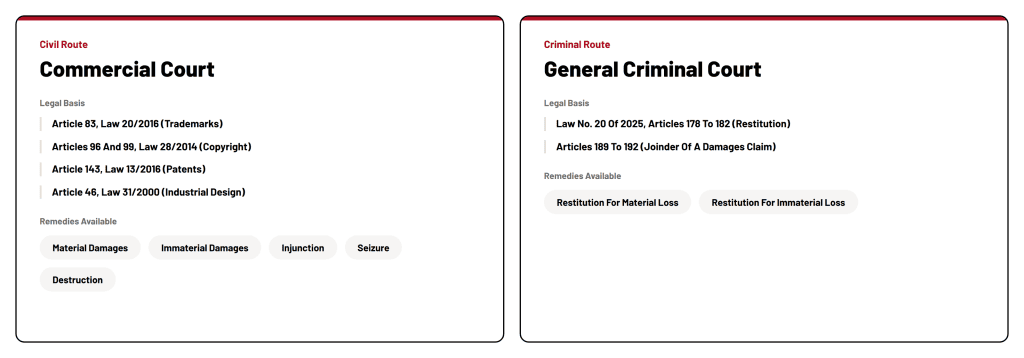
This decides how an infringement file is framed. A claim against a licensee who stopped paying is a contract claim with a contract measure. A claim against a counterfeiter is an unlawful-act claim, where the doctrine is contested. Rights holders enforcing their IP rights face the same choice between the civil and criminal routes.
What the Courts Have Awarded
Indonesian courts do grant expectation loss, where the figure is tied to something a panel can verify.
| Decision | What was claimed | What was awarded |
|
MA No. 1248 K/Pdt/1998 (18 Dec 2000) |
Around IDR 11.83 billion in lost profit after a Hong Kong principal ended a sole distributorship | Cassation granted, unlawful act found, damages including the expected profit |
|
MA No. 225 K/Pdt/2013 (25 Sept 2013) |
Counterclaim over an unpaid purchase price for shophouses and kiosks | IDR 2 billion, plus interest, penalty, and IDR 200 million in lost expected profit |
|
Hardwood v Unilever, No. 30/Pdt.Sus-Merek/2020/PN.Niaga.Jkt.Pst (18 Nov 2020) |
IDR 33 billion material and IDR 75 billion immaterial, IDR 108.04 billion in total | IDR 30 billion at first instance, covering mark development, promotional spend, and claimed lost gross margin, then set aside on cassation in No. 332 K/Pdt.Sus-HKI/2021 |
Two patterns run through them. Expected profit survives when it is expressed as a commercial figure the claimant already keeps, such as gross margin, contracted volumes, or a licence rate. Immaterial loss carries very little weight. Hardwood pleaded IDR 75 billion in immaterial loss, more than twice its material figure, and the sum it won was smaller than the material claim alone. That award did not survive cassation. That reversal turned on the mark, not the quantum. The Supreme Court held that “Strong” was an ordinary English word rather than the claimant’s coinage.
Restitution Under the 2025 Criminal Procedure Code
Law No. 20 of 2025, the new Criminal Procedure Code, took effect in January 2026 and and introduced a new framework for criminal procedure. Chapter XIII sets out compensation, rehabilitation, restitution, and state compensation at Articles 173 to 188, with restitution at Articles 178 to 182. Chapter XIV covers joinder of a damages claim to the criminal case at Articles 189 to 192. Restitution is defined as payment imposed on the offender or a third party under a court order. It covers material and/or immaterial loss suffered by the victim or the victim’s heirs.
That definition matters because IP infringement, including trademark infringement in Indonesia is a criminal offence, as is copyright infringement. Criminal complaints also remain the faster route in practice, as the back-to-back criminal royalty prosecutions showed. A brand owner running a complaint now has a statutory basis for asking that the same proceeding order money, not only a sentence.
Read against Indonesia’s new criminal codes, restitution is an option worth preparing rather than a settled remedy.
Commercial and Strategic Insights
1. Build the damages record before the complaint. Gross margin per unit, verified sales decline, promotional spend on the mark, and investigation costs are the figures a panel can check.
2. Itemise every head separately, and keep the immaterial figure proportionate. One consolidated number invites the treatment in Decision No. 3138 K/Pdt/1994. Hardwood’s immaterial claim ran to more than twice its material figure and added nothing to the award it briefly won.
3. Choose the basis deliberately. A licence or distribution agreement puts the claim under Articles 1246 to 1248, with a recognised head for lost profit. A claim against an unrelated infringer runs on Article 1365, where expectation loss is arguable rather than assured.
4. Treat the criminal route as a recovery route. Where a complaint is already the plan, restitution and joinder under Law No. 20 of 2025 belong in the strategy. Prepare the loss evidence to the same standard.
Connect With Us
SKC Law advises clients across all intellectual property categories in Indonesia, from filing strategy and portfolio management through to enforcement and litigation.
For enquiries on damages and IP litigation in Indonesia, contact our team at enquiries@skclaw.id.
Follow us on LinkedIn for updates on intellectual property in Indonesia.
This content is provided for general information only and does not constitute legal advice. For advice on specific matters, contact enquiries@skclaw.id.