Constitutional Court Decision 255/PUU-XXIII/2025 and the DGIP Circular Letter
Indonesia’s Constitutional Court (Mahkamah Konstitusi or MK) has restored the exclusion on second-use inventions in patent law in Indonesia, reversing a key change made by the 2024 amendment. Since then, the Directorate General of Intellectual Property (DGIP) has issued a Circular Letter (Surat Edaran) on how the decision will be applied in examination.
For applicants with claims to new uses of known products, or to new forms of known compounds, the two documents now set the rules. Below, we outline what the Court decided, what the Circular Letter says, and what applicants may wish to review.

What the Constitutional Court Decided
On 28 August 2026, the Court partially granted a judicial review petition against Law No. 65 of 2024, the Third Amendment to Law No. 13 of 2016 on Patents. A coalition of patient groups, civil society organisations and individual patients brought the petition. The Court’s official announcement summarises the ruling.
Article 4(f) Is Reinstated
Article 4(f) of the 2016 Patent Law listed two kinds of discovery that do not qualify as inventions:
- New uses. A new use of a product that already exists or is known.
- New forms. A new form of an existing compound that does not produce a significant increase in efficacy and has a related, already known chemical structure.
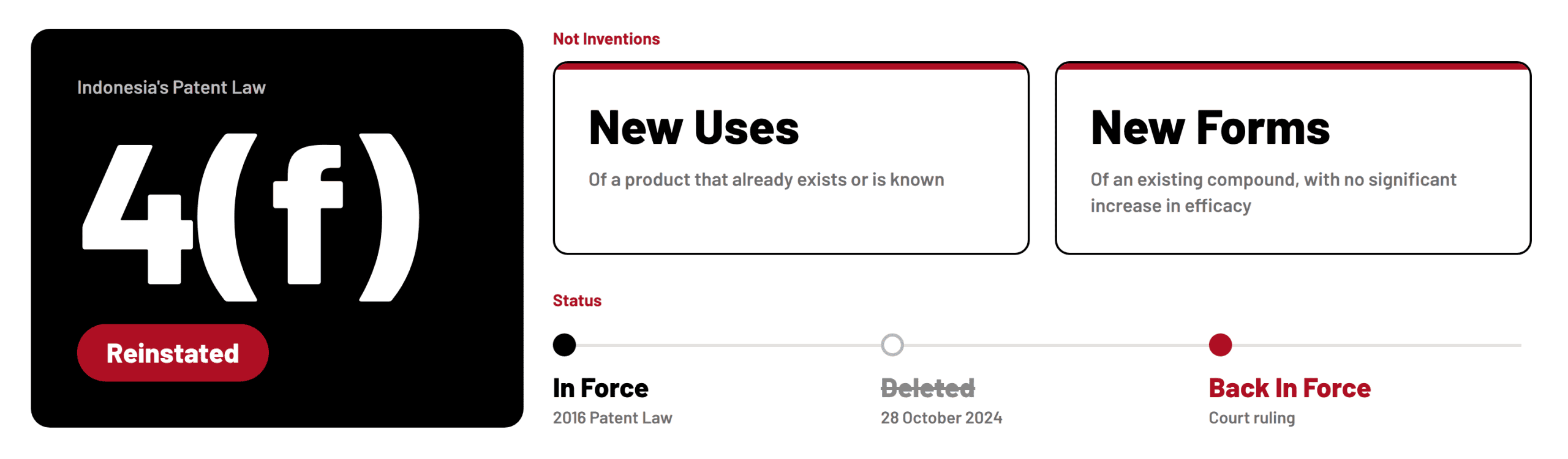
Law No. 65 of 2024 deleted this provision with effect from 28 October 2024. In its ruling, the Court held that the word “deleted” is conditionally unconstitutional unless read as the original Article 4(f) text. As a result, the exclusion is back in force under the patent law of Indonesia.
The 2016 Elucidation Returns
In addition, the Court set aside the 2024 Elucidation of Article 4(f), which had been drafted to make room for second medical use claims. It reinstated the 2016 Elucidation as the official interpretation. That Elucidation defines “existing or known products” broadly. The list covers tools, goods, machines, compositions, formulas, methods, uses, compounds and systems, whether still patented or already in the public domain.
For “significant”, it uses a pharmaceutical example. A single structural difference gives amoxicillin a broader antimicrobial spectrum and higher stability than ampicillin, so amoxicillin shows a significant increase in efficacy.
The Court’s Reasoning
Its decision rests on the constitutional right to health and the right to legal certainty. It observed that existing tools under the Patent Law operate downstream, after a patent is granted. These include government use of patents, parallel imports, the Bolar provision and compulsory licensing. In the Court’s view, an exclusion that works at the application stage gives stronger protection to public health and to the national generic medicine industry.
Further Points: “Use” and Patent Appeals
The Definition of Invention
Law No. 65 of 2024 added “use” to the statutory definition of an invention. According to the Court, this definition cannot be read in isolation. Instead, it is harmonised with the reinstated exclusion, and the Court asked lawmakers to adjust the Patent Law accordingly.
Who May File a Patent Appeal
The petition also asked the Court to define “interested party” in Article 70(1), which governs appeals against a decision to grant a patent. On this point, the Court declined to rewrite the provision. However, its reasoning states that the phrase is already inclusive. Standing is not limited to direct commercial or financial loss. According to the Court, it reaches entities representing the public interest, such as patient groups, consumer protection bodies, health rights organisations and independent researchers. The Court also noted that the Patent Appeal Commission (Komisi Banding Paten) should assess standing carefully.
What the DGIP Circular Letter Says
On September 2026, the DGIP issued Circular Letter No. HKI-16.KI.05.10 on the implementation of the decision. It is addressed to Ministry officials, IP consultants and stakeholders. Its stated aim is a uniform reading of the decision across patent examination and appeals. Its key points are:
| Article 4(f) applies again | The DGIP treats Article 4(f) of the 2016 Patent Law as back in force. |
| The 2016 Elucidation guides examination | It serves as the reference for assessing the limits of an invention. |
| “Use” is read with Article 4 | The definition of invention is applied systematically and is limited by the exclusions in Article 4. |
| Appeal standing is read broadly | The DGIP asks that legal interest in an appeal not be limited to direct commercial or financial loss, and that it cover parties representing the public interest or consumer protection |
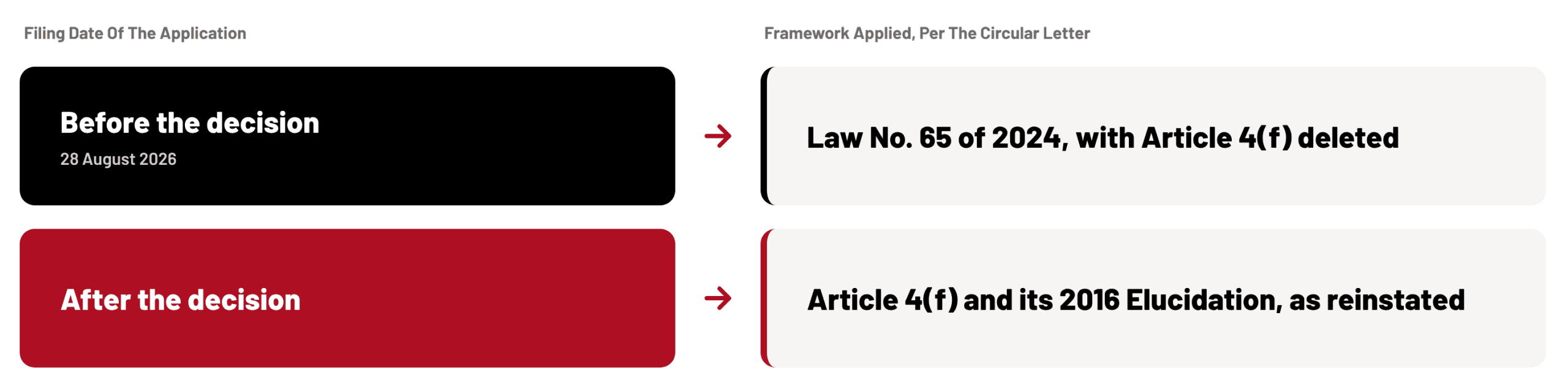
| Earlier applications keep the 2024 rules | Applications related to Article 4(f) filed before the decision remain subject to Law No. 65 of 2024 |
Notably, the Circular Letter frames the exclusion as covering second-use applications in all fields of technology, not only pharmaceuticals. It also lists Minister of Law Regulation No. 6 of 2026 on Patent Applications among its legal bases. Read our blog on the new Patents Regulation 6/2026.
What This Means for Patent Applicants
Filing date now matters. Together, the decision and the Circular Letter divide applications under patent law in Indonesia into two groups. For applications filed before the decision, the DGIP has indicated that the 2024 position continues to apply. For applications filed afterwards, claims to a new use of a known product fall within the restored exclusion. So do claims to a new form of a known compound without a significant increase in efficacy.
For patent holders, the appeal reasoning is a separate point. Article 70 allows appeals against decisions to grant a patent. Under the Court’s reasoning, the parties who may bring such appeals include public-interest groups as well as commercial competitors.
Practical Steps for Patent Applicants
Check filing dates. Confirm the filing date of each Indonesian application with second-use or new-form claims.
Review pending claims. Identify which claims fall within either limb of Article 4(f), using the 2016 Elucidation as the reference point.
Revisit filing plans. For new applications under the Patent Law in Indonesia, factor in the restored exclusion from the outset, across all fields of technology.
Monitor legislative follow-up. Track any amendment to the Patent Law that follows the Court’s request to lawmakers.
Contact us to discuss your patent portfolio or any aspect of intellectual property services in Indonesia.
Read more about our services on our website, or follow us on LinkedIn for regular updates.
This content is provided for general information only and does not constitute legal advice. For advice on specific matters, contact enquiries@skclaw.id.