Sennheiser Reclaiming Its Domain Name
For over 80 years, Sennheiser has been synonymous with precision audio engineering. From microphones to headphones, audio professionals and consumers worldwide recognise the SENNHEISER name. Yet for more than a decade, the Indonesian country-code domain sennheiser.co.id sat in someone else’s hands.
An unaffiliated third party registered the domain in 2011 and held it without active use ever since. And in 2025, Sennheiser instructed SKC Law to recover it.
The Challenge
A Domain Parked for 14 Years
An individual operating under the name “Delta Musik” registered the domain sennheiser.co.id on 5 July 2011. This registrant had no connection to Sennheiser and held no trademark registration for the word SENNHEISER or any of its variations in Indonesia. The domain never hosted an active website. Instead, it sat idle for over 14 years.
Sennheiser’s Position in Indonesia
Meanwhile, Sennheiser held registered trademarks in Indonesia. The company had also been active in the Indonesian market for years, operating direct-to-consumer e-commerce in Indonesian Rupiah through its official website.
As a result, the situation presented a clear intellectual property disputes problem. A third party held a domain identical to Sennheiser’s registered trademark – without authorisation, without legitimate use, and in a way that blocked the brand owner from securing its own country-code domain.
The Approach
Choosing the PPND Framework
SKC Law advised Sennheiser to pursue the matter through Indonesia’s Penyelesaian Perselisihan Nama Domain (PPND). This dispute resolution service framework, administered by Pengelola Nama Domain Internet Indonesia (PANDI), follows ICANN’s Uniform Domain Name Dispute Resolution Policy (UDRP). It offers a structured, cost-effective alternative to court proceedings for domain name disputes.
The Three-Element Test
To succeed, a complainant must establish three elements cumulatively. First, the disputed domain must be identical or confusingly similar to a registered trademark owned by the complainant. Second, the registrant must have no legitimate right or interest in the domain. Third, the registrant must have registered or used the domain in bad faith.
Building the Strategy
SKC Law’s team – led by Partner Bagus Lestanto and Associate Syafa Noer – compiled the complaint with comprehensive supporting evidence.
This included trademark registration from Indonesia and other countries, company establishment documents from Germany, and proof of Sennheiser’s business activities in Indonesia. The team also provided trademark search results confirming that the registrant held no competing rights, along with search results showing that the word “SENNHEISER” is exclusively associated with the brand owner.
Syafa handled the day-to-day coordination of the PPND proceedings, including correspondence with the PANDI Secretariat and management of procedural deadlines.
The Process
SKC Law filed the PPND complaint on 20 November 2025. The process unfolded through three defined stages.
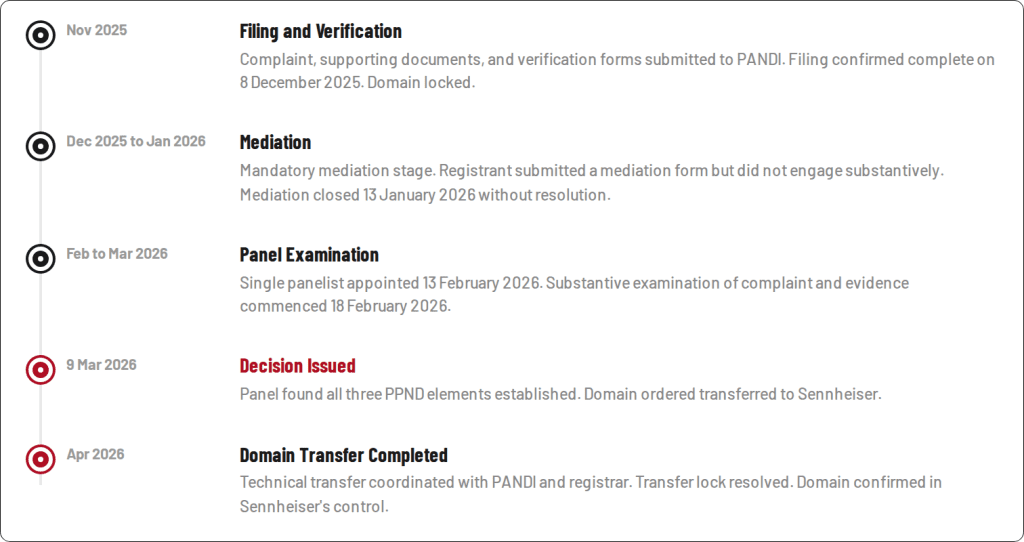
Filing and Verification (November 2025)
SKC Law submitted the pre-complaint verification form, mediation form, complaint form, and all supporting documentation. The PANDI Secretariat confirmed the filing as complete. At that point, PANDI locked the domain to prevent transfer or modification during the proceedings.
Mediation (December 2025 – January 2026)
The PPND framework requires a mediation stage before a dispute proceeds to panel examination. In this case, the registrant submitted a mediation form but did not engage substantively. The mediation stage closed without resolution.
Panel Examination (February – March 2026)
PANDI appointed a single panelist on February 2026. The substantive examination of the complaint and supporting materials began shortly after.
The Decision
On March 2026, the panel issued its decision (Putusan-061-0326). It found that all three elements under the PPND framework had been fulfilled.
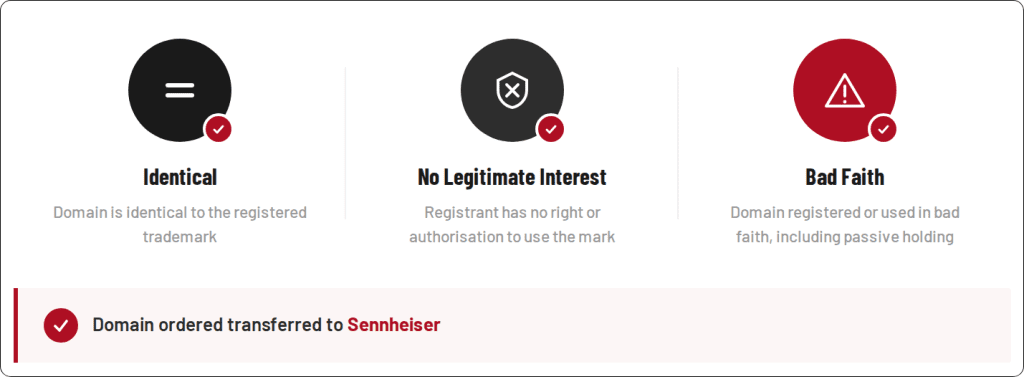
Identity with a Registered Trademark
The panel confirmed that the domain sennheiser.co.id is identical to Sennheiser’s registered trademarks. Adding the country-code top-level domain (.co.id) did not create any distinguishing element.
No Legitimate Right or Interest
The panel noted that the registrant held no trademark registrations for SENNHEISER, had no affiliation with Sennheiser, and had never received authorisation to use the mark. Applying the WIPO consensus view on burden of proof, the panel concluded that the registrant failed to demonstrate any legitimate right or interest.
Bad Faith Registration and Use
The panel applied the “passive holding” doctrine. It found that the domain had sat parked without active use since registration. SENNHEISER is a highly distinctive mark with no dictionary meaning in any language. The registrant’s failure to respond or provide evidence of good-faith use reinforced the finding of bad faith.
Given the mark’s distinctiveness, the panel also observed a risk of likelihood of confusion among consumers who might associate the domain with the brand owner. Consequently, the panel found that the registrant had registered the domain to prevent the trademark owner from using it.
The panel ordered the domain sennheiser.co.id transferred from the registrant to Sennheiser.
Post-Decision
A PPND decision requires registrar implementation. SKC Law managed transfer, coordinating with Pengelola Nama Domain Internet Indonesia and the registrar to secure the EPP code and lift locks. When issues arose, we resolved them directly, completing transfer within five months.
Practical Takeaways
Domain squatting remains a real risk
Domains held by unauthorised parties can persist for years, increasing risks of confusion, misuse, and brand dilution. Early action is critical.
Indonesia’s PPND process is effective
Indonesia’s domain dispute system offers a structured, cost-efficient recovery route. In this case, resolution-from filing to transfer-was completed within five months.
Trademark registration is essential
A strong case depends on registered rights. Securing trademarks in Indonesia, and relevant jurisdictions, is key, alongside managing country-code domains as part of a broader protection strategy.
Passive holding can be bad faith
Even unused domains may constitute bad faith, particularly for distinctive marks, in line with global principles such as those under World Intellectual Property Organization (WIPO).
SKC Law advises on domain name disputes and brand protection in Indonesia. Contact our team at enquiries@skclaw.id to discuss your brand protection strategy.
Follow us on LinkedIn for updates on intellectual property in Indonesia. Submit a custom inquiry via our Contact Page.
This content is provided for general information only and does not constitute legal advice. For advice on specific matters, contact enquiries@skclaw.id.