Reciprocal Trade Agreement Upgrades Border Enforcement System
Indonesia has committed to open its customs recordation system. Under the United States–Indonesia Agreement on Reciprocal Trade, signed on 19 February 2026, the government agreed to eliminate the local domicile requirement for recordation. It also agreed to reduce the large deposits demanded before border authorities will seize goods. Border interception is potentially the most efficient anti-counterfeiting tool available in Indonesia, and opening this up to foreign applicants is a significant step forward.
Both barriers were named again in the United States Trade Representative (USTR) 2026 Special 301 Report, which kept Indonesia on the Priority Watch List. Our blog goes through how recordation works today, what happens when Customs detains a shipment, and the changes we expect to see.
Indonesia’s Legal Basis for Border Measures
| Legal Basis | Articles 54–64 of the Customs Law, Law No. 17 of 2006, amending Law No. 10 of 1995 |
| Government Regulation | Government Regulation No. 20 of 2017 governs import and export goods suspected of infringing intellectual property (IP) rights |
| Implementing Regulation | Minister of Finance Regulation No. 40/PMK.04/2018 |
| System Implementation | The Directorate General of Customs and Excise (DGCE) began operating the system on 21 June 2018 |
Two routes run in parallel. Under the Customs recordal route, a rights holder records its rights in advance. DGCE can then act on its own initiative, and that route covers trademarks and copyright only. Under the judicial route, DGCE acts on a temporary suspension order from the Commercial Court. Prior recordation is not required, and the judicial route reaches the wider set of rights covered by Regulation 20/2017.
Neither route covers everything. Suspension does not apply to passenger baggage, crew goods, border-crosser goods, or postal and courier consignments not intended for commercial purposes.
How Recordation Works
The applicant must be a business entity domiciled in Indonesia. It must also own or hold the registered right. An agent, distributor or importer cannot apply on its own account. A pending application is not enough, because the mark must already be registered.
Applications go to DGCE’s Directorate of Enforcement and Investigation. They are filed online through the Customs-Excise Information System and Automation (CEISA) portal for IP rights, known as CEISA HKI. Supporting documents are listed in the annex to Regulation 40/2018. They include the application and statement letters, the deed of establishment, the business identification number, the company tax number, the nominated examiner’s identity card, the trademark certificate and a product booklet. Two powers of attorney are also required: one from the trademark proprietor or copyright holder authorising the Indonesian-domiciled business entity, and one from that entity authorising its agent or proxy.

The rights holder nominates that examiner, and DGCE interviews them to confirm the product’s authenticity markers and distribution channels. The examiner does not have to work for the rights holder. They do have to know the product, which makes periodic retraining a live obligation rather than a formality.
DGCE’s published procedure puts the interview invitation two to three days after a complete file. The certificate then issues in CEISA about a week later. In practice, a recordation runs for a maximum of one year from approval and covers every port in Indonesian territory. It is renewable if the extension is filed at least 30 days before expiry. Changes to company or product details must be notified.
The Clock Starts at Detention
Recordation is free. Acting on it is not. DGCE notifies the rights holder when it identifies suspect goods. The rights holder then has two days to decide whether to apply to the Commercial Court for a suspension order. A guarantee of IDR 100 million must be paid to Customs before the goods can be held, in the form of a bank or insurance guarantee. Under Article 24 of that regulation the rights holder carries the operational costs of storage, handling and labour.
A second guarantee sits behind that one. A rights holder applying for the suspension order must also provide a guarantee to the Commercial Court. That guarantee protects the importer, not the state. If the goods are found not to infringe, their owner can claim compensation from the rights holder who asked for the suspension, and the Court can order the guarantee to be used to pay it. An extension of the suspension must be matched by an extension of the guarantee.
That amount is not fixed. It follows the customs value of the shipment – the declared invoice value, plus import duties and taxes. Customs provides that figure in a resume document once the first guarantee is in place. That figure is then tested at the hearing against the value of the goods held. The IDR 100 million guarantee to Customs must be issued by a perception bank on the Customs list and remain valid for 60 days. The form of the guarantee is not specifically, leaving it to each Court’s discretion, with some Courts reportedly require a cash deposit rather than a bank guarantee.
This means the cost of a detention scales with the shipment. A rights holder has to arrange both guarantees inside the same two-day window. If the goods are found to infringe, the guarantee to the Commercial Court is returned in full to the rights holder. The operational guarantee to Customs may be used to cover outstanding operational costs, with any remaining amount returned in accordance with the applicable procedures.
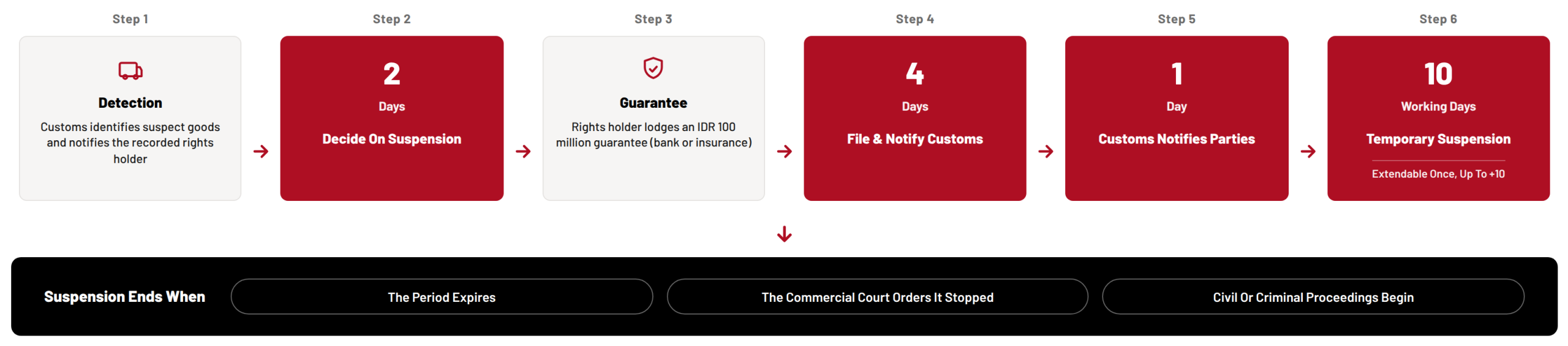
Three events end the suspension: the period expires, the Commercial Court orders it stopped, or civil or criminal proceedings begin. The rights holder may also pursue an out-of-court settlement with the importer or exporter. A rights holder that does not respond in time will see the goods released to the importer. Repeated silence can put the recordation itself under review.
Customs Seizure Activity
There are currently 123 registered Customs recordals, comprising 122 trademarks and one LEGO copyright. The trademark count is up from 94 recorded marks as of 10 November 2025, according to DGCE data. The register is not short of serious brand owners: Procter & Gamble, 3M, Unilever, Schneider Electric, GlaxoSmithKline, Galderma, Timken and Shimano, alongside Indonesian groups such as Djaja Harapan.
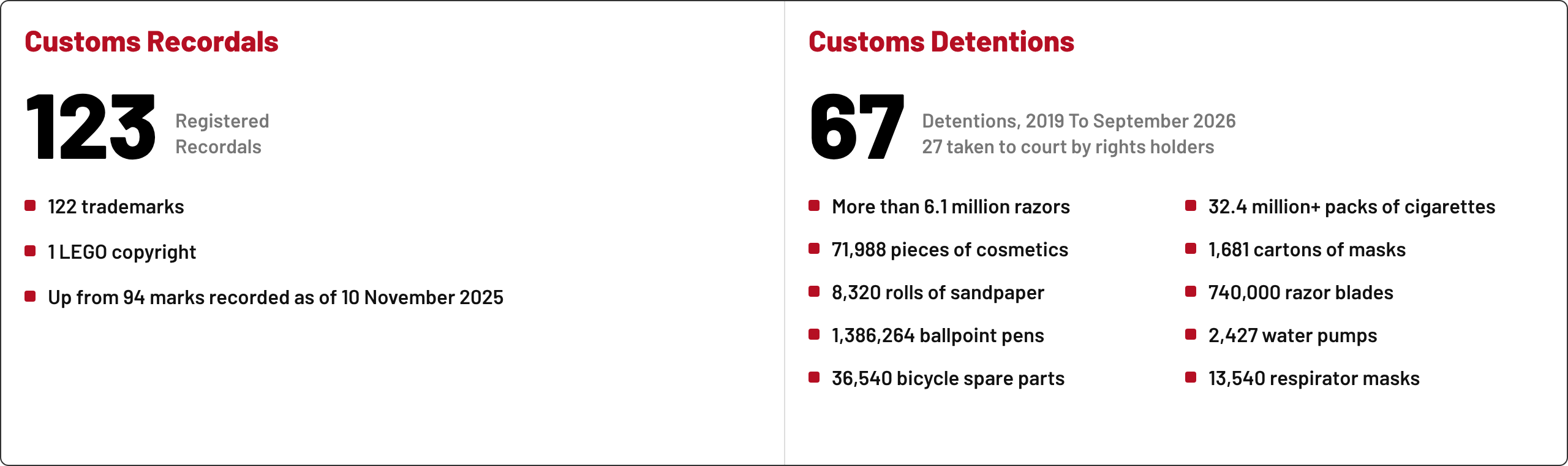
DGCE recorded 67 detentions under the system between 2019 and September 2026. Rights holders took 27 of them to court. Detained volumes included more than 32.4 million packs of cigarettes (about 649 million sticks) and more than 6.1 million razors, together with 1,386,264 ballpoint pens, 740,000 razor blades, 71,988 pieces of cosmetics, 1,681 cartons of masks (6,408,000 pieces), 2,427 water pumps, and 8,320 rolls of sandpaper. The list also covers 36,540 bicycle spare parts, 13,540 respirator masks, 6,400 safety goggles, 576 pieces of personal protective equipment, 620 rolls of reflective sticker and 488 rolls of adhesive tape.
This year, SKC Law has also handled four Customs detention cases involving suspected infringing products bearing SHIMANO trademarks.
Two points are worth tracking. DGCE is building an artificial intelligence capability to analyse import and export flows, though a dedicated trademark-infringement detection tool is still in progress. Separately, DGCE will not approve a recordation for a mark that is itself under dispute in court. Other marks in the same portfolio are unaffected.
Practical Implications for Rights Holders
The commitments will require implementing regulations before anything changes in practice. However, commitments and implementation are different things.
It is worth attending to preparation now.
Confirm the portfolio is registration-complete. Recordation depends on a registered mark, so any gap in core classes is a gap at the border.
Resolve the domicile question early. Foreign rights holders without an Indonesian entity should establish how they meet the local establishment requirement, or whether the reform removes it for them.
Budget for the guarantees, not the filing. Two guarantees and the operational costs are the real cost of border enforcement, and the second one scales with the value of the shipment. The two-day window leaves no room to arrange them after a call from Customs.
Nominate and retrain the examiner. DGCE interviews the nominated examiner, and a recordation is only as good as that person’s current product knowledge.
SKC Law’s Enforcement & Intelligence Team advises rights holders on customs recordal, investigations, warning letters, criminal raids and civil proceedings in Indonesia. For an earlier account of how coordination between DGIP, Customs and the courts is meant to work, see our previous blog.
Contact us to discuss your border enforcement strategy or any aspect of intellectual property services in Indonesia.
Read more about our enforcement capabilities, or follow us on LinkedIn for regular updates.
This content is provided for general information only and does not constitute legal advice. For advice on specific matters, contact enquiries@skclaw.id.