Marketplace Compliance and IP Vulnerability
Indonesia’s e-commerce market is one of the largest in Southeast Asia, with platforms such as Tokopedia (now integrated with TikTok Shop) and Shopee serving as the primary channels through which millions of products reach consumers daily. For brand owners, these platforms present both a commercial opportunity and a potential risk of intellectual property infringement.
The speed and simplicity of marketplace seller registration create structural vulnerabilities that can be exploited by counterfeiters and IP infringers.
Our blog goes through the seller registration processes on Tokopedia and Shopee, analyses where IP risks might arise, and provides practical guidance for businesses.
The Regulatory and Compliance Landscape
Indonesia’s e-commerce sector operates within a regulatory framework that is relevant to marketplace seller registration and IP enforcement:
Government Regulation No. 80 of 2019 on Trade Through Electronic Systems (PP 80/2019). This regulation requires e-commerce platforms to verify the identity of merchants operating on their platforms. Both Tokopedia and Shopee comply with this by requiring identity documents (KTP for individuals; NIB and/or NPWP for corporate entities) during registration. However, the regulation does not mandate trademark clearance or product authenticity checks at the point of seller onboarding.
Law No. 20 of 2016 on Trademarks and Geographical Indications. Indonesia’s trademark legislation provides the legal basis for enforcement against infringing use of registered trademarks, including in online environments. Rights holders can pursue civil claims, file criminal complaints with the police, and issue takedown requests to platforms. The law does not, however, impose proactive monitoring obligations on e-commerce platforms.
Law No. 1 of 2023 (KUHP – New Criminal Code). The new Criminal Code, which came into force on 2 January 2026, introduces corporate criminal liability for IP infringement. This is particularly relevant to sellers operating through corporate entities on marketplace platforms, as the registered business, not just the individual behind it, may now face criminal prosecution.
Law No. 28 of 2014 on Copyright. Online distribution of infringing copyrighted content, including product images, designs, and digital goods, is addressable under the Copyright Law. Platforms are required to take down infringing content upon receipt of a valid complaint, and sellers who upload copyrighted material without authorisation are directly liable.
Taken together, these regulations create a compliance framework that requires platforms to verify seller identity but does not require them to screen for IP infringement at the point of registration. The practical effect is that enforcement is reactive: rights holders must detect infringement after it occurs, rather than relying on platforms to prevent it.
How Marketplace Registration Might Create IP Risk
The registration processes on both Tokopedia and Shopee are designed for speed and accessibility. An individual seller can create an account, upload a KTP, and begin listing products within a matter of hours.
Registration Requirements: A Comparison
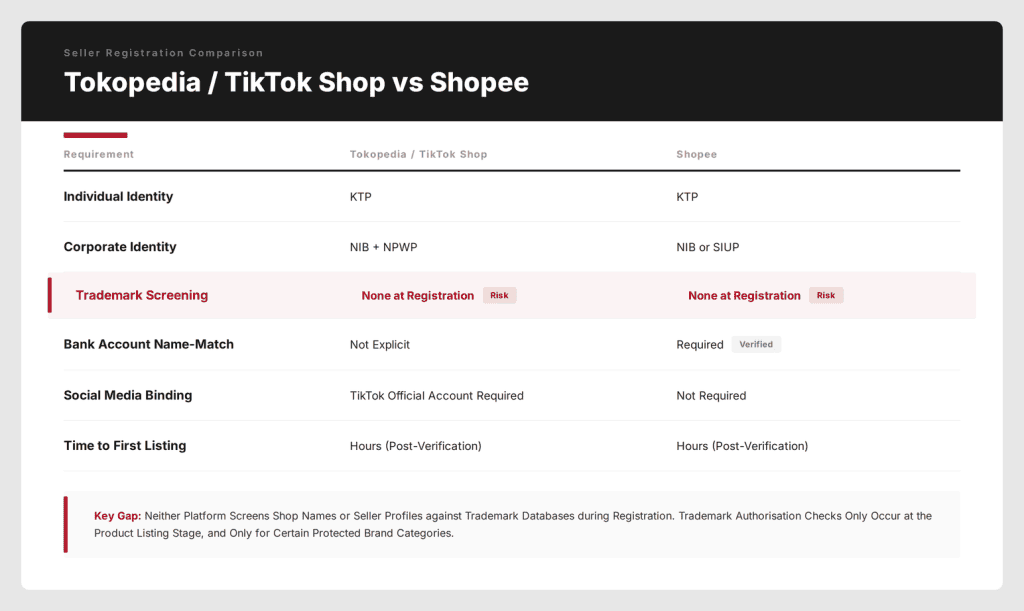
Several characteristics of the registration process are particularly relevant from an IP enforcement perspective:
- No trademark clearance at registration. Neither platform screens shop names or seller profiles against trademark databases during registration. A counterfeit seller can register a shop name that is identical or confusingly similar to a registered trademark, creating immediate consumer confusion and brand dilution. Trademark authorisation checks only occur at the product listing stage, and only for certain protected brand categories.
- Minimal identity verification for individuals. A single KTP is sufficient to register and begin selling on both platforms. There is no verification of business legitimacy, supply chain relationships, or product authenticity. Counterfeit sellers could exploit this to create accounts, list infringing products, and generate sales before detection.
- Speed of activation compounds the problem. Both platforms are designed to move sellers from registration to active listing as quickly as possible. While this is commercially beneficial, it means that infringing products can appear in search results and reach consumers within hours of a seller account being created.
- Re-registration after takedown. Although both platforms limit each phone number or email to one account, enforcement experience shows that determined infringers obtain new phone numbers and identity documents to create replacement accounts. The cost and effort of doing so is low relative to the potential revenue from counterfeit sales.
From Online Infringement to Offline Enforcement
One of the most significant developments in IP enforcement in Indonesia is the growing recognition that online marketplace infringement frequently connects to offline distribution networks. A seller listing counterfeit products on Shopee or Tokopedia is typically not operating in isolation; they are often supplied by physical warehouses, manufacturing operations, or wholesale distribution centres.
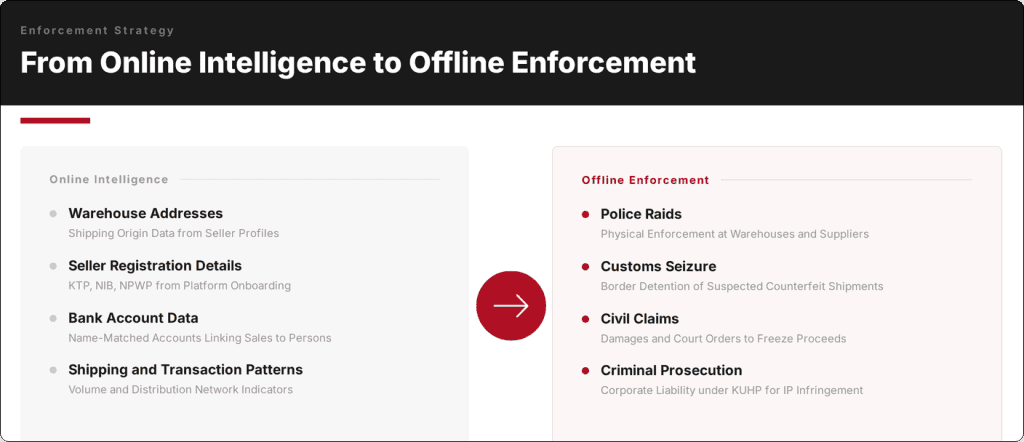
The connection between online and offline infringement creates both risks and strategic enforcement opportunities for rights holders.
Data generated through marketplace activity, such as seller identities, warehouse locations, shipping origins, and transaction records, can be leveraged to trace infringers to real individuals or legally accountable entities. This information, including corporate registration details (NIB and NPWP) and verified bank account data, provides strong evidentiary links that support civil claims, asset-freezing measures, and customs actions.
At the same time, platform-held data can be accessed by authorities in criminal investigations and, when combined with evidence from physical raids, significantly strengthens enforcement outcomes.
In practice, combining online monitoring with offline action is an effective enforcement approach.
Platform-Based Risks in E-Commerce
Beyond the registration process itself, several platform-specific features create additional IP risks that rights holders should be aware of:
- Live commerce and video selling. Counterfeit products promoted through live streams can generate significant sales volume in a very short period, often before automated detection systems or rights holder monitoring can intervene. The quick nature of live content also makes evidence preservation more challenging.
- Content-driven discovery. TikTok Shop’s integration with Tokopedia means that product discovery increasingly happens through short-form video content rather than traditional search. This presents the potential to leverage viral content to drive traffic to infringing listings.
- Promotional programmes amplify visibility. Shopee’s Gratis Ongkir XTRA programme and platform-wide campaigns (Flash Sales, seasonal promotions) can amplify the visibility of infringing products. Counterfeit sellers who participate in these programmes benefit from platform-subsidised exposure, making their products more competitive against legitimate offerings.
Practical Steps for Rights Holders
Given the structural characteristics of Indonesia’s e-commerce marketplace environment, rights holders are advised to adopt a comprehensive, multi-layered approach to brand protection:
- Register trademarks with platform brand protection programmes. Both Tokopedia/TikTok Shop and Shopee operate brand registry and authorisation systems. Registering trademarks with these programmes enables proactive screening of product listings and gives rights holders access to expedited takedown procedures. On Tokopedia/TikTok Shop, brand authorisation is verified against WIPO databases. Shopee operates a Brand Portal for registered rights holders.
- Establish systematic online monitoring. Relying on platform detection alone is insufficient. Rights holders should implement regular monitoring of marketplace listings, using keyword searches, image recognition tools, and price-point analysis to identify suspicious sellers. Monitoring should cover both product listings and seller profiles (including shop names that may infringe trademarks).
- Use platform takedown mechanisms efficiently. Both platforms provide IP complaint and takedown processes. Filing takedown requests promptly and with complete supporting documentation (trademark registration certificates, evidence of infringement, authorised seller lists) accelerates removal and strengthens the rights holder’s enforcement track record on the platform.
- Connect online intelligence to offline enforcement. Marketplace data; including warehouse addresses, seller contact details, shipping patterns, and corporate registration information, should be obtained to identify physical supply chains.
- Record trademarks with Indonesian Customs. Customs recordation (rekordasi) enables the Directorate General of Customs and Excise to detain shipments of suspected counterfeit goods at the border. This is particularly effective against counterfeit products that are imported for distribution through marketplace platforms.
- Consider criminal enforcement where appropriate. Under Indonesia’s trademark legislation and the new Criminal Code (KUHP), criminal complaints can be filed with police authorities against sellers and their supply networks. Criminal enforcement is particularly effective as a deterrent.
- Maintain accurate records for civil claims. Evidence and/or information obtained through platform enforcement can support civil claims for damages. Rights holders should maintain detailed records of all enforcement actions, takedowns, and repeat infringers to build a comprehensive body of evidence.
SKC Law’s Enforcement & Intelligence Team advises rights holders on all aspects of online and offline IP enforcement in Indonesia, including marketplace monitoring, takedown programmes, criminal enforcement, and customs recordation. Contact our team to discuss your brand protection strategy or follow us on LinkedIn for the latest updates.
This content is provided for general information only and does not constitute legal advice. For advice on specific matters, contact enquiries@skclaw.id.