Balancing Creator Rights with Cultural Practice
Indonesia is grappling with one of the most contentious intellectual property rights issues of our time: who owes royalties for music, under what circumstances, and through what mechanisms? What began as a copyright infringement dispute involving a Balinese restaurant chain has evolved into a national conversation about fairness, cultural values, and the evolving nature of intellectual property in the digital age. The case settled amicably, but debates on music royalties persist, raising fundamental questions on fair compensation, governance, and balanced regulation.
A Copyright Case That Sparked Debate
The debate intensified after high-profile copyright infringement cases in Indonesia involving a well-known restaurant branch in Bali. The core issue was whether royalties were owed to (LMKN) for playing music on its premises. The restaurant viewed it as ambiance; LMKN argued any commercial use requires payment.
The case sparked nationwide debate. Businesses feared unexpected costs, with some stopping Indonesian music altogether, while creators raised concerns over unpaid use. The dispute exposed a gap between public understanding of copyright and its legal application in Indonesia.
Law 28/2014 and Permenkum 27/2025
Music royalties in Indonesia are governed under Law No. 28 of 2014 on Copyright, as amended by Constitutional Court Decision No. 84/PUU-XXI/2023. Creators hold exclusive economic rights, including reproduction, distribution, performance, and public communication. Commercial use of music requires approval from the relevant rights holder or obtain a licence through a Lembaga Manajemen Kolektif (LMK), with royalties triggered by use in public-facing services.
The framework was updated by Minister of Law Regulation No. 27/2025 (Permenkum 27/2025) , which strengthens LMKN’s role in royalty collection and distribution, introduces provincial units, reduces operational costs, and mandates data reporting to the national music database.
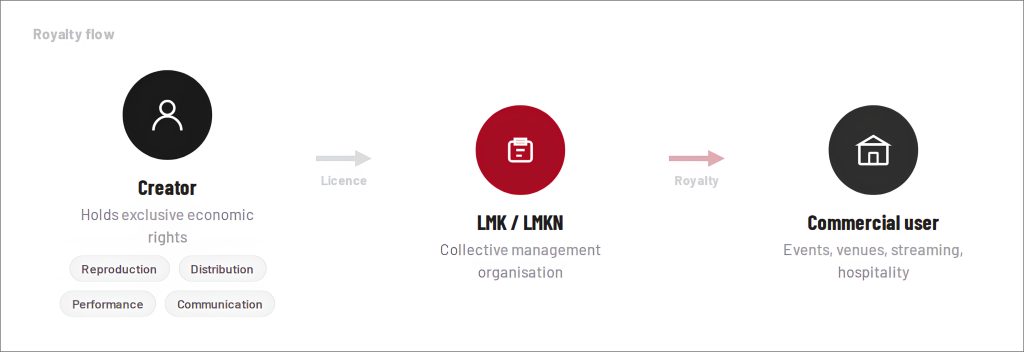
It also clarifies that royalty obligations fall on event organisers or business owners, not performers, as reinforced by the Supreme Court’s decision in the Agnez Mo v Ari Bias dispute.
Classification Framework and Public Awareness
To address the confusion, Permenkum 27/2025 defines 23 categories of analogue-format commercial uses requiring royalties, such as accommodation facilities, food and beverage establishments, discotheques and nightclubs, shopping centres, sports facilities, fitness centres, transportation services, entertainment and tourism venues, office buildings, cinemas, karaoke venues, and commercial events. Digital-format commercial services are also now expressly covered, including audio and video streaming, downloads, and simulcasts.
Despite this, awareness remains low, with many businesses unclear on obligations or questioning their applicability. Lack of awareness creates risk: businesses face potential liability under copyright laws, while creators struggle for fair copyright protection.
Violations of economic rights during unauthorised commercial use may result in up to four years of imprisonment and fines of up to Rp 1 billion. These penalties apply to both copyright and related rights infringements. See our analysis of recent criminal copyright royalty cases.
Royalty Tariffs
Specific tariff structures are set out under Decree of the Minister No. HKI.2.OT.03.01-02 of 2016 (“Decree 2/2016”). Rates vary by business category:
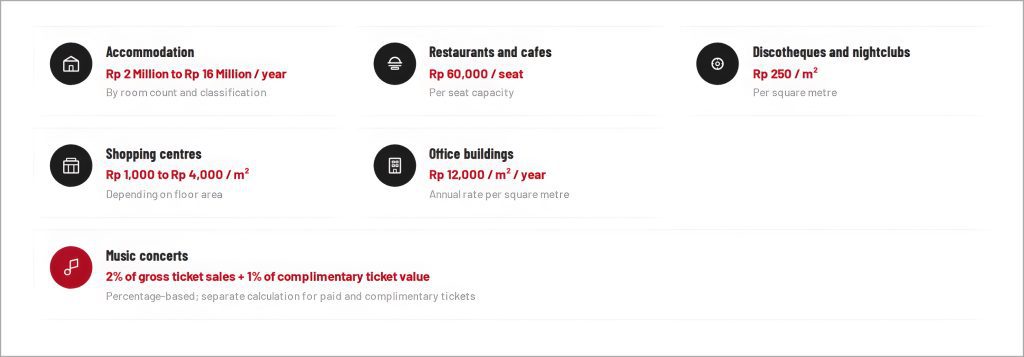
LMKN, working with the Directorate General of Intellectual Property, is currently reviewing tariffs for micro-, small-, and medium-scale enterprises. Until revised tariffs are issued, the Decree 2/2016 rates remain in force.
Collection, Pooling, and Distribution: How the System Works
Permenkum 27/2025 structures royalty management into three functions: collection, pooling, and distribution. All royalties are consolidated into a single LMKN account, with regional LMKN units prohibited from holding separate accounts. Distribution is carried out through LMKs, which must report to LMKN twice a year.
In April 2026, LMKN introduced a dual system: distributions based on song usage data and non-data distributions, supported by an Unlogged Performance Allocation (UPA) scheme to improve fairness.
Indonesia’s Push for International Standards
Indonesia is increasingly active in shaping international frameworks on digital music royalties, as reported by The Jakarta Post. This gained further momentum when Indonesia hosted the inaugural ASEAN Collective Management Organizations (CMO) Forum in Bali. Minister of Law Supratman Andi Agtas called on WIPO, CISAC, and International Federation of the Phonographic Industry (IFPI) to establish global royalty governance standards.
The government positioned itself as a regulator overseeing governance, rather than being directly involved in royalty management. The forum brought together CMOs from across the ASEAN region, including Indonesia’s Kereta Commuter Indonesia (), reflecting Indonesia’s growing role in shaping global IP norms.
Structural Challenges in the System
Indonesia’s royalty management system continues to evolve, with opportunities to enhance accuracy and transparency. LMKN currently relies on usage reports submitted by users and improving data consistency and monitoring tools could strengthen fairness and accountability in royalty distribution.
The definition of “commercial use” is intentionally broad to ensure coverage across sectors. However, ongoing refinement of tariff structures – currently based on Ministerial Decrees – may further improve proportionality between the actual commercial usage and applicable royalty rates.
Businesses should also remain mindful that even where artists permit free use, rights may still be held by composers, lyricists, or record labels, requiring appropriate licensing for commercial use.
Practical Steps for Businesses and Creators
Businesses should review their operations against the 23 clarified categories, assess their royalty liability, and consider licensing arrangements through the Sistem Informasi Lagu dan/atau Musik (SILM) system, accessible at pdlm.dgip.go.id. Payment documentation must be maintained, and businesses should ensure that payments are made only through official LMKN accounts.
Musicians should ensure their work is properly registered with an LMK and uploaded to the PDLM. Creators who are not yet LMK members may still claim royalties from LMKN, provided they submit verified supporting data. Copyright protection begins at creation, but registration with the Directorate General of Intellectual Property (DGIP) provides evidentiary benefits for enforcement.
Conclusion
The debate over music royalties in Indonesia reflects ongoing efforts to align international frameworks with cultural values and economic realities. Key priorities include improving transparency, proportionality, accessibility, and consistent enforcement. Comparisons with more developed and established systems provide useful reference points.
With the Copyright Bill under review and LMKN updating distribution policies for 2026, the royalty landscape continues to improve, requiring active engagement from both businesses and creators.
| SKC Law advises businesses and creators on Indonesian copyright laws and royalty obligations. Whether you need guidance on licensing, royalty compliance, or protecting your creative work, contact our team at enquiries@skclaw.id. |
Follow us on LinkedIn for updates on intellectual property in Indonesia.
Submit a custom inquiry via our Contact Page.
This content is provided for general information only and does not constitute legal advice. For advice on specific matters, contact enquiries@skclaw.id.