What the Industrial Design Bill would change for registration, protection terms, and international filing
After more than two decades, Indonesia is preparing to rewrite the law that protects how its products look. The Industrial Design Bill (Rancangan Undang-Undang Desain Industri) is a government-sponsored amendment to Law No. 31 of 2000. It sits on Indonesia’s 2026 Priority National Legislation Programme, the Program Legislasi Nasional (Prolegnas). That is the shortlist of bills the House of Representatives, the Dewan Perwakilan Rakyat (DPR), prioritises for the year. For any business that protects the look of a product, the bill would change the basics of industrial design registration in Indonesia. Three things stand out: how long protection lasts, when a design must be filed, and how to take it abroad.
Why the Law Is Changing Now
The timing is not accidental. Indonesia has become one of the fastest-growing design-filing jurisdictions in the world. It is now straining against rules built for a smaller, slower market. The World Intellectual Property Organization (WIPO) tracks these filings. Its 2024 World Intellectual Property Indicators ranked Indonesia first in the world for growth in design applicants in 2023. That growth reached 37.3 percent, ahead of India and Russia. WIPO’s 2025 report showed the momentum holding. Indonesia posted one of the sharpest design-count increases among the world’s top 20 IP offices, at 25.3 percent. The Directorate General of Intellectual Property (DGIP) received 7,926 design applications in 2024. Of these, 5,827 were domestic and 2,099 came from abroad.
Lawmakers wrote the current law for a different economy. It has governed Indonesian design protection since 2000. In that time, e-commerce, social media, and a whole creative sector have emerged. Designers now launch products on Instagram, TikTok, and online marketplaces. Most do so long before they think about registration. Under the present rules, that early exposure can destroy the novelty a design needs. The bill sets out to close that gap and align the law with how design businesses work, particularly in fast-cycle industries such as fashion, textiles, handicrafts, and seasonal consumer products.
The push to act is not new. An amendment to the 2000 law has appeared on the national legislation agenda across successive years. The government has again carried it onto the 2026 priority list as unfinished business. What has changed is the pressure behind it. A register handling record volumes now runs on a novelty rule written before designers launched products online, while businesses increasingly seek protection for digital products, user interfaces, and technology-related designs that were not specifically regulated for protection when the current law was enacted.
What the Bill Would Change
As a full amendment of the 2000 law, the draft would rework several pillars of design protection at once. Its exact provisions are not yet settled, so the comparison here reflects the reform’s anticipated direction rather than final text. The table sets the proposed system against the current one.
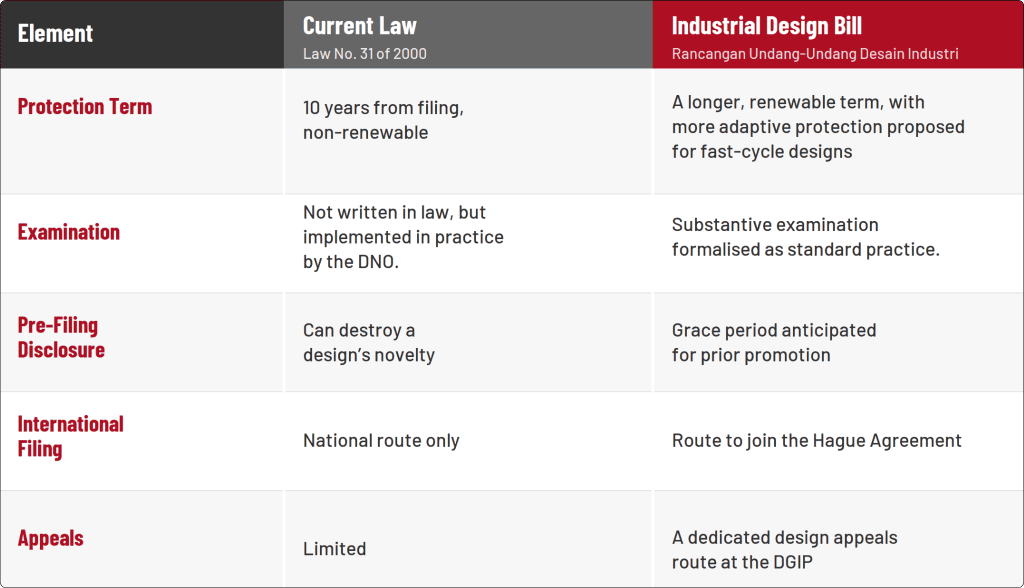
Two of these changes matter most to businesses. The first is the term. A renewable structure would treat a textile print and an engineered component differently, as they do not need the same protection. It would also let a valuable design stay protected beyond the current flat ceiling. The second is disclosure. Today’s law treats prior disclosure as a threat to novelty. That routinely catches designers who post on social media before filing. A grace period would give them a window to file after a product is first disclosed. Several other jurisdictions already allow this.
Closer to home, the draft also targets the marketplaces that sell design piracy. It would make mall operators and trading-venue administrators liable for allowing infringing goods on their premises.
A Route to International Filing
The bill also looks outward. Indonesia is not yet a member of the Hague Agreement, the international design system run by WIPO. Through a single Hague application, a business can protect up to 100 designs across more than 90 countries. Among Indonesia, Vietnam, and Thailand, only Vietnam has completed accession, effective December 2019. Indonesia’s largest filing partners are already inside the system. China joined in 2022, and Japan, Korea, and the United States joined in 2014 and 2015. Joining would align Indonesia with the very markets its designers most often file into and out of.
How Indonesia Compares in the Region
The reform would also bring Indonesia closer to its neighbours. Vietnam is a close example, with a substantive examination system, a 15-year total term, and membership in the Hague framework. Indonesia has implemented the first two, leaving Hague membership as the key remaining target. For businesses filing across Southeast Asia, a modernised Indonesian system would help. It would make regional design strategy more consistent and less dependent on separate national routes.
What This Means for Designers and Brand Owners
For now, nothing has changed. The bill is still pending, and Law No. 31 of 2000 remains in force. A design disclosed on social media today can still lose its novelty. Protection still runs for a flat ten years. Clients ask two questions above all. How long does protection last, and can a design already disclosed online still be registered? Those are precisely the two this bill sets out to answer. Until it passes, the conservative answers hold: file before you publish and treat that term as the ceiling. SKC Law files and manages industrial design registrations in Indonesia.
What to Do Before the Law Changes
A few steps put a design-led business in a stronger position whichever way the timeline runs.
|
File early |
Registering before any public launch is still the only reliable way to protect novelty under the current law. It is better to file pending products now than hold them for the new regime.
|
|
Map the portfolio |
A short portfolio audit shows which designs you have registered, and where. It also shows what sits exposed today, and which designs suit the Hague route later. |
|
Watch the bill |
Negotiators are still settling the term, the grace period, and the examination standard. The detail that drives filing strategy has not settled yet. |
Moving Forward
Rewriting a 26-year-old law is a significant step in Indonesia’s wider IP reform agenda. The design bill does not stand alone. The same 2026 priority programme also carries an amendment to the Copyright Law, one that would advance the Jakarta Protocol Roadmap. IP reform is moving on several fronts at once. The filing numbers show why the pressure has built. Indonesia is a market growing faster than almost any other, still working from a statute written in 2000. A bill on the priority list, however, is not yet law. That gap is where careful filing strategy earns its keep. Businesses that prepare now will be ready when the new system arrives. That means registering what matters and following the detail.
Need help with industrial design registration, portfolio audits, or international filing strategy in Indonesia? Talk to our team.
Submit a specific enquiry via the Contact Page.
Follow us on LinkedIn for further updates on Indonesian IP.
This content is provided for general information only and does not constitute legal advice. For advice on specific matters, contact enquiries@skclaw.id.