Effective August, Indonesia Introduces Higher Registration and Renewal Fees
Indonesia has re-set its intellectual property filing fees. The new schedule is set out in Peraturan Pemerintah (PP) No. 30 of 2026, a Government Regulation signed on 2 July 2026. It raises what the Directorate General of Intellectual Property (DGIP) charges general applicants to file and renew trademarks – now about 55.6% higher for the general (“Umum“) tier. New rates take effect 30 days after promulgation, in early August 2026.
Trademark filings and renewals that slips past the deadline will now incur roughly double in government fees. Filings and renewals lodged before the effective date keep the current, lower rates.
What PP 30/2026 Changes
PP 30/2026 governs Penerimaan Negara Bukan Pajak (PNBP) or Non-Tax State Revenue collected by the Ministry of Law (Kementerian Hukum), under the framework that Law No. 9 of 2018 established. DGIP operates inside that ministry, administering every trademark and patent filing, renewal, and examination. PP 30/2026 revoked the prior schedule, PP 45/2024, and its promulgation was recorded in the State Gazette (Lembaran Negara) 2026 No. 72, with the new tariffs themselves starting in early August 2026.
Two points frame everything below. First, each listed figure is a ceiling. The regulation defines the tariff as the “batas tarif tertinggi” – the highest rate the office may charge. Second, the rise falls on general filers alone. Micro and small enterprise (“Usaha Mikro dan Usaha Kecil“, UMK) rates hold flat at every tier.
New Trademark and Patent Fees
Trademark filing and renewal
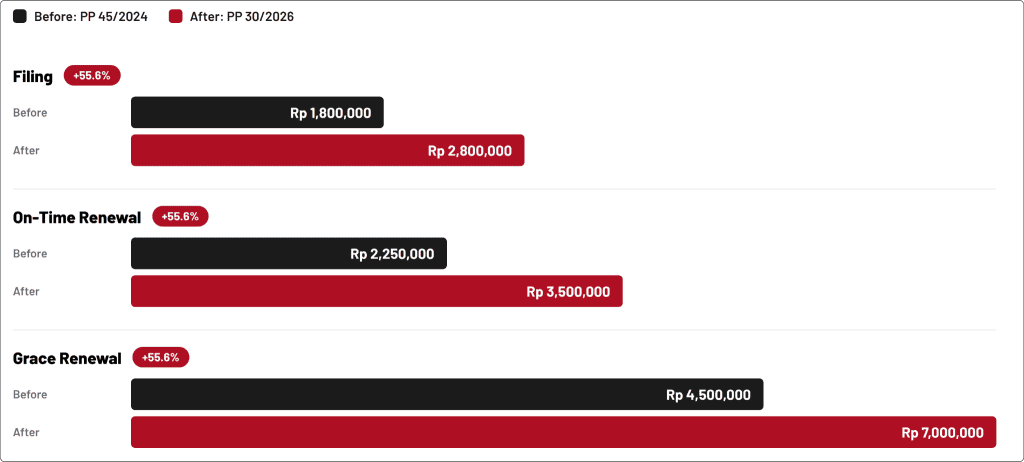
General-tier trademark fees move as follows, per class.
|
Trademark service (general / Umum, per class) |
PP 45/2024 (old) |
PP 30/2026 (new) |
Change |
|
Filing (registration application) |
Rp 1,800,000 |
Rp 2,800,000 |
+Rp 1,000,000 (+55.6%) |
|
On-time renewal (6 months before or at expiry) |
Rp 2,250,000 |
Rp 3,500,000 |
+Rp 1,250,000 (+55.6%) |
|
Grace renewal (within 6 months after expiry) |
Rp 4,500,000 |
Rp 7,000,000 |
+Rp 2,500,000 (+55.6%) |
New patent examination options
Two new patent services have been introduce, both elective.
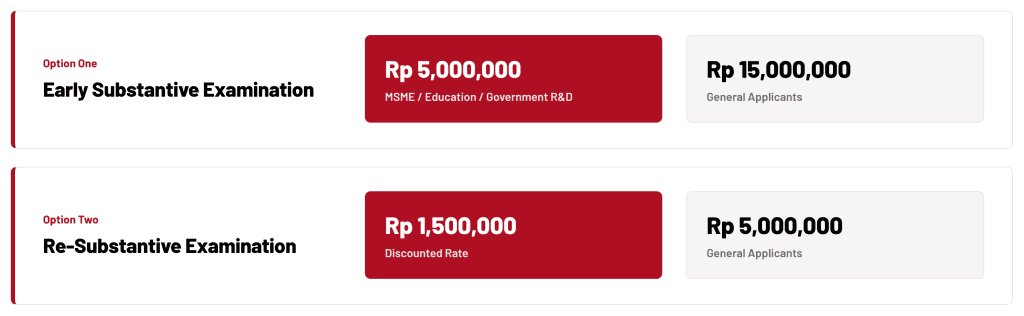
Early substantive examination lets an applicant bring the substantive review forward. It costs Rp 5 million for micro, small and medium enterprises, educational institutions, and government research bodies. General applicants pay Rp 15 million per application.
Re-substantive examination lets an applicant reopen a review after a refusal, a correction, or a deemed withdrawal. It costs Rp 1.5 million at the discounted rate. General applicants pay Rp 5 million per application.
Regular substantive examination now costs Rp 3.5 million, up from Rp 3 million. An accelerated Patent Prosecution Highway (PPH) route is now expressly included in the schedule. Patent registration applicants therefore gain two new levers to control examination timing, at a price.
What This Means for Businesses
Total IP filings have risen 4.5 times in a decade, from 74,893 applications in 2015 to 339,304 in 2024 – that count comes from the 2025 DJKI IP Outlook Report. We have analysed the portfolios we manage and observed the same trend: active filers tend to hold marks across several classes, so a per-class increase quietly reaches the whole portfolio at once.
An additional Rp 1,250,000 for a single on-time renewal may appear modest. However, for businesses managing multiple trademarks across several classes, the cumulative increase can become a meaningful part of their annual IP budget.
Renewal during the six-month grace period now costs Rp 7,000,000 per class for general applicants, compared with Rp 3,500,000 for an on-time renewal. Timely renewals therefore offer even greater cost efficiency under the revised fee schedule.
Micro and small enterprise filers keep their existing trademark rates in full. For patent applicants, the two new services add flexibility. Early examination compresses the timeline; re-examination revives an application after a setback. While these tools help straightforward acceleration and revival, they suit some pending applications better than others.
Practical Steps for Business
| The window closes in early August 2026. Consider four moves.
Audit the renewal calendar |
map every general-tier mark with a renewal due later in 2026 against the effective date. |
| Move what can move | filings and renewals lodged now stay at the current, lower general rates. |
| Weigh the new patent options | price early or re-substantive examination where a pending application’s timing genuinely matters. |
| Bring the sequencing to counsel | which marks to accelerate, and whether the patent tools fit, turns on each portfolio. |
Acting Before the Change
This increase is a scheduled tariff adjustment under the PNBP framework, not a change to how marks are examined or protected. Matters lodged before the effective date stay on the current general rates, subject to the usual transitional treatment. Early action keeps the budget math intact, so the practical question is one of timing.
Contact us for further guidance.
Submit a custom inquiry via our Contact Page.
Follow us on LinkedIn for more IP expertise.