What Indonesia’s Stronger IP Enforcement Means for Rights Holders
Indonesia has stepped up IP enforcement against online piracy. Its Directorate General of Intellectual Property (DGIP) blocked 1,004 websites distributing pirated content between 1 January 2025 and 11 May 2026. Those sites carried pirated films and television, digital books, webtoons and comics, and unauthorised broadcasts.
These takedowns come as the United States kept Indonesia on its 2026 Priority Watch List for intellectual property. For rights holders, the more useful signal is operational rather than diplomatic. Indonesia now runs a copyright site-blocking system at scale, and foreign content owners can use it. This blog goes through the scale of the enforcement, how the blocking system works, and what it means for rights holders.
The Scale of the Takedowns
The blocked sites fall into four categories of copyright infringement. Film and television streaming made up the largest share, followed by digital publishing.
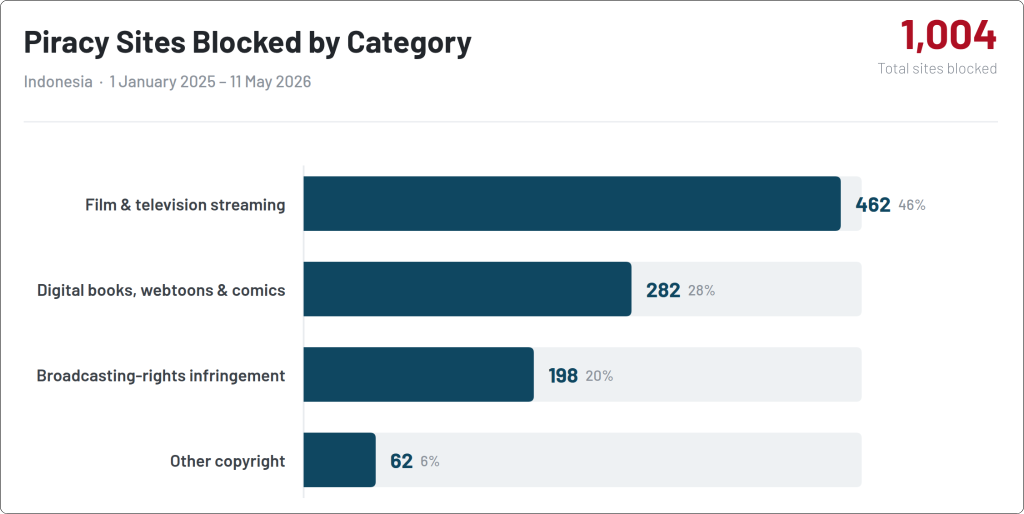
Of the total, 885 sites were blocked during 2025 and a further 119 by 11 May 2026. Bapak Hermansyah Siregar, Director General of Intellectual Property, has tied the programme to Indonesia’s commitment to protect rights holders “from home and abroad”. Enforcement sits with the DGIP’s Directorate of Law Enforcement, led by Bapak Arie Ardian Rishadi, Director of Law Enforcement.
How the Blocking System Works
The programme runs under Indonesia’s Law No. 28 of 2014 on Copyright, supported by Joint Regulations No. 14 and No. 26 of 2015 and the Minister of Law Regulation No. 47 of 2025. In practice, it works as a complaint-driven process. A rights holder reports infringing URLs, the DGIP verifies each one, and confirmed sites are referred for blocking.
Access is terminated at the network level. The DGIP works with the Ministry of Communications and Digital Affairs, which oversees internet service providers, to disable verified sites. Foreign rights holders do not need a local presence to take part. Complaints are routinely filed through local representatives, and recent activity has focused on pirated film, webtoon, and Korean drama streaming networks reported on behalf of overseas content owners. Indonesia has also introduced a new mechanism for reporting online IP infringement that rights holders can use.
Indonesia and the USTR Priority Watch List
The United States Trade Representative (USTR) kept Indonesia on its Priority Watch List in the 2026 Special 301 Report, citing concerns about piracy and enforcement deterrence. Indonesia has answered with activity rather than argument. Its IP office describes intellectual property protection as vital to a healthy investment climate. It treats that protection as both an international obligation and a domestic priority.
The investment stakes are concrete. Washington ranked as Indonesia’s fourth-largest source of foreign direct investment in the first quarter of 2026, at USD 1.3 billion.
What This Means for Rights Holders
For content owners and brand protection teams, the significance of the DGIP programme is practical. It turns site-blocking into a repeatable enforcement channel. SKC Law’s Enforcement and Intelligence Team runs online monitoring and takedown programmes for rights holders in Indonesia, work that regularly begins as platform surveillance and grows into coordinated enforcement action. A blocking complaint is often the first step in that sequence, not the last.
However, blocking addresses access, not the source. A disabled domain can reappear under a new address, and site-blocking does nothing to reach the operators behind organised piracy. These takedowns also sit alongside reform commitments that Indonesia has yet to implement in full, and commitments and implementation are different things. Rights holders should treat the blocking system as one layer of a monitoring and enforcement programme, not a complete remedy.
Practical Steps for Rights Holders
The DGIP programme reinforces the value of a proactive, multi-layered approach to protecting content and brands in Indonesia.
- Register and record the underlying rights. A blocking complaint is strongest when it rests on a registered right. Copyright recordal in Indonesia gives a rights holder clear standing to act.
- Use the blocking channel as a standing function. Online monitoring and takedown reporting should run as an ongoing operational function. Foreign owners can file through local counsel without a local presence.
- Pair takedowns with intelligence-led enforcement. Blocking removes access; reaching the operators behind large-scale piracy still calls for investigation and, where warranted, coordinated raids, as in our case study on the destruction of over 34,000 counterfeit bearings in Jakarta.
- Track the reform commitments. Indonesia has made enforcement commitments under international pressure that will require implementing regulations. Rights holders should monitor these and adjust strategy as new mechanisms become available.
SKC Law’s Enforcement and Intelligence Team advises rights holders on online monitoring, takedowns, customs recordal, investigations, and coordinated enforcement across Indonesia.
Contact us to discuss your enforcement strategy or any aspect of intellectual property services in Indonesia: enquiries@skclaw.id
Read more about our enforcement capabilities on our website, or follow us on LinkedIn for regular updates.
This content is provided for general information only and does not constitute legal advice. For advice on specific matters, contact enquiries@skclaw.id.