How the Directorate General of Intellectual Property Runs Alternative Dispute Resolution
Mediation is not only an alternative to IP litigation in Indonesia. For two categories of dispute it is a statutory precondition to criminal prosecution. Article 95(4) of the Copyright Law requires the parties to attempt mediation before criminal prosecution, except in cases of piracy. Article 154 of the Patent Law imposes a similar requirement on criminal claims for patent infringement. Rights holders contemplating criminal prosecution should therefore ensure that the applicable mediation requirement has been addressed.
One forum for IP dispute mediation in Indonesia is the Directorate General of Intellectual Property (DGIP), known in Indonesia as Direktorat Jenderal Kekayaan Intelektual (DJKI). We’ll help to explain when mediation is compulsory, how DGIP handles a request, and what the parties can agree through the process.
Mediation as a Statutory Precondition in Indonesia
Indonesia’s three main IP statutes treat mediation differently. Copyright and patent matters carry a compulsory step before the criminal prosecution. Trademark matters do not.
| Right | Provision | Mediation status |
| Copyright and related rights | Article 95(4), Law No. 28 of 2014 | Compulsory before the matter proceeds to criminal prosecution, except for piracy, where the parties are known or located in Indonesia |
| Patents and simple patents | Article 154, Law No. 13 of 2016 | Compulsory before the matter proceeds to criminal prosecution |
| Trademarks and geographical indications | Article 93, Law No. 20 of 2016 | Optional, alongside arbitration and the Commercial Court |
Article 95(4) has a stated rationale. The Director General of Intellectual Property appeared for the President before the Constitutional Court on 30 June 2025. In Case No. 28/PUU-XXIII/2025 he described the Copyright Law as administrative penal law and characterized criminal enforcement as an ultimum remedium (a last resort) mechanism. Consistent with that approach, Article 95(4) requires the parties to attempt mediation before pursuing criminal prosecution.
The mediation requirement applies to criminal prosecution, not to the enforcement action that comes before it. Rights holders can still report infringement and pursue a raid to seize infringing goods without first attempting mediation. The mediation step needs to be addressed only before the matter proceeds to prosecution in court.
Outside those two triggers, mediation sits alongside arbitration and the Commercial Court as an elective route. The Elucidation to Article 95(1) of the Copyright Law defines alternative dispute resolution as mediation, negotiation or conciliation. Importantly, the Commercial Court has jurisdiction over many statutory IP disputes that do proceed to litigation.
Where Mediation Sits Inside DGIP
Mediation is handled by the Directorate of Law Enforcement, through its Sub-directorate for Prevention and Alternative Disputes. An alternative dispute resolution working team receives and processes requests. That team also manages scheduling and communication between the parties, and appoints a certified mediator.
DGIP reports seven mediators at the sub-directorate. A further 29 IP mediators sit across the 29 regional offices of the Ministry of Law. Those mediators have handled copyright, trademark, patent and industrial design disputes since 2021. DGIP is also expanding mediator certification, including through cooperation with the World Intellectual Property Organization (WIPO).
How a Mediation Request Proceeds
Requests are filed through the online IP infringement complaint system. A party can apply with or without a complaint already registered at DGIP. That matters for a rights holder facing the Article 95(4) precondition. In practice, the mediation step does not depend on lodging a report first.
A complete file carries the applicant’s full details, a signed mediation request letter, the identity of the applicant and any legal counsel, proof of IP ownership or registration, and a short description of the dispute with supporting evidence. DGIP then runs an administrative examination. Once the file is complete, DGIP appoints a certified mediator from headquarters or from a regional office.
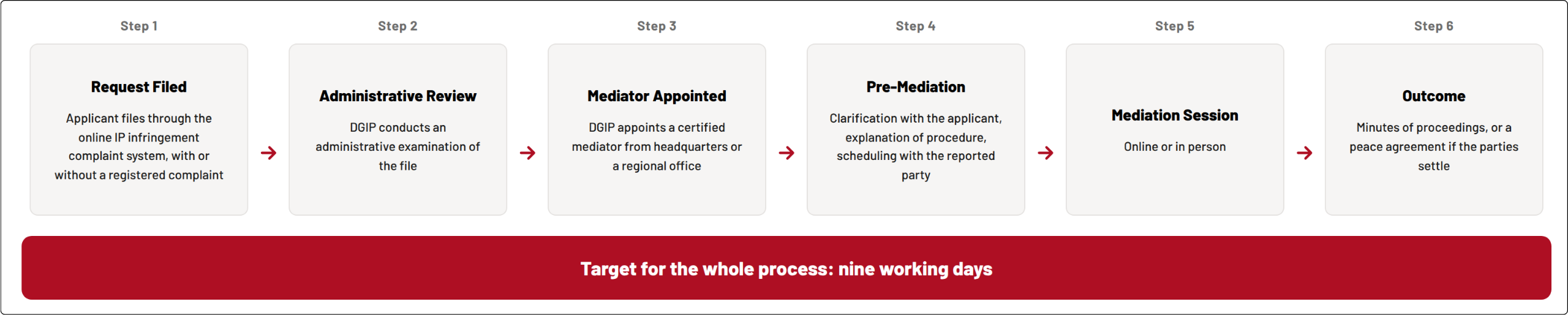
The mediator conducts a pre-mediation stage. That involves calling the applicant for clarification, explaining the procedure, and setting a schedule with the reported party. Where the parties settle, the mediator draws up minutes or a peace agreement. DGIP targets a maximum of nine working days for the whole process. Where no agreement is reached, enforcement then continues under the applicable provisions.
What the Parties Can Agree
The scope is wider than a settlement figure. Either side can request mediation – a rights holder or a reported party – before, during or after a complaint. Parties may resolve the dispute without agreeing any payment of damages. They can also agree how infringing goods will be destroyed and who will carry out the destruction. Sessions run online or in person.
The process is voluntary and works by invitation. If a party fails to attend three times, the mediation closes. Mediation discussions are conducted on a confidential basis. While that confidentiality protects a genuine negotiation, it also means a determined infringer in a non-piracy copyright matter can absorb three invitations before the case proceeds to criminal prosecution.
Five Years of IP Disputes Resolved Without Litigation
Between 1 January 2022 and 20 May 2026, DGIP resolved 104 mediation requests. Copyright and trademark disputes dominate the caseload.
Those numbers are modest against the volume of IP filings in Indonesia. However, the direction of travel is consistent. That restorative-justice framing sits alongside the broader shift in Indonesia’s new Criminal Code (KUHP). Furthermore, DGIP has built a mechanism for reporting online IP infringement into the same platform that receives mediation requests.
Practical Implications for Rights Holders
Check the statute before taking a criminal matter forward. For copyright infringement that is not piracy, and for patent infringement, mediation is a statutory step that should be addressed before the matter proceeds to criminal prosecution.
Treat mediation as a route, not a formality. The nine-working-day target and the online filing route make it faster than any contested option. The parties also control the terms.
Put destruction terms on the table early. Agreeing the method and the party responsible removes the most common sticking point in counterfeit matters.
Assume the file will be tested. DGIP examines proof of ownership or registration at the administrative stage. An incomplete portfolio record will stall the request before a mediator is appointed.
SKC Law’s Dispute Resolution & Advisory practice advises rights holders on negotiation, settlement agreements and alternative dispute resolution in Indonesia. SKC Law’s Enforcement & Intelligence Team runs the criminal route where settlement is not available. For how the criminal prosecution runs when mediation is not taken up, see our note on recent criminal copyright royalty cases.
Contact us to discuss a dispute or any aspect of intellectual property services in Indonesia.
Read more about our dispute resolution capabilities, or follow us on LinkedIn for regular updates.
This content is provided for general information only and does not constitute legal advice. For advice on specific matters, contact enquiries@skclaw.id.