The Jakarta Protocol Progressing Toward Indonesian Law
Indonesia’s proposed “Jakarta Protocol” has progressed from concept to legislative discussion. What began as a multilateral initiative aimed at improving global royalty transparency is now expected to be incorporated into Indonesia’s revised Copyright Law (RUU Hak Cipta), with the bill targeted for completion in 2026. Below, we’ll outline the Protocol’s objectives, its implications for rights holders and platforms, and the steps businesses should take to prepare.
What is the Jakarta Protocol?
The Jakarta Protocol is a roadmap intended to address gaps in international regulation concerning the synchronisation of audiovisual and digital music rights. It seeks to improve the distribution of royalties between creators and stakeholders in the creative industry; an issue that has gained much attention with the growth of digital streaming platforms.
According to Bapak Bob Hasan, Chairman of the DPR’s Legislative Body (Baleg), the Jakarta Protocol roadmap is expected to be incorporated into the RUU Hak Cipta, with the process currently underway.
Current Legal Framework
Indonesia’s current copyright framework provides a starting point for the Jakarta Protocol:
Law No. 28/2014 on Copyright (UU28/2014) protects audiovisual works and digital music through copyright and related rights. Cinematographic works receive economic rights protection for 50 years from first publication. Songs and musical compositions are protected for the creator’s life plus 70 years, while performers’ and phonogram producers’ related rights last 50 years from fixation.
Government Regulation No. 56/2021 (PP 56/2021) governs royalty management for songs and music. Royalties collected by the Lembaga Manajemen Kolektif Nasional (LMKN) are distributed to creators and rights holders based on usage data reported through the Sistem Informasi Lagu dan/atau Musik (SILM) through the Lembaga Manajemen Kolektif (LMK).
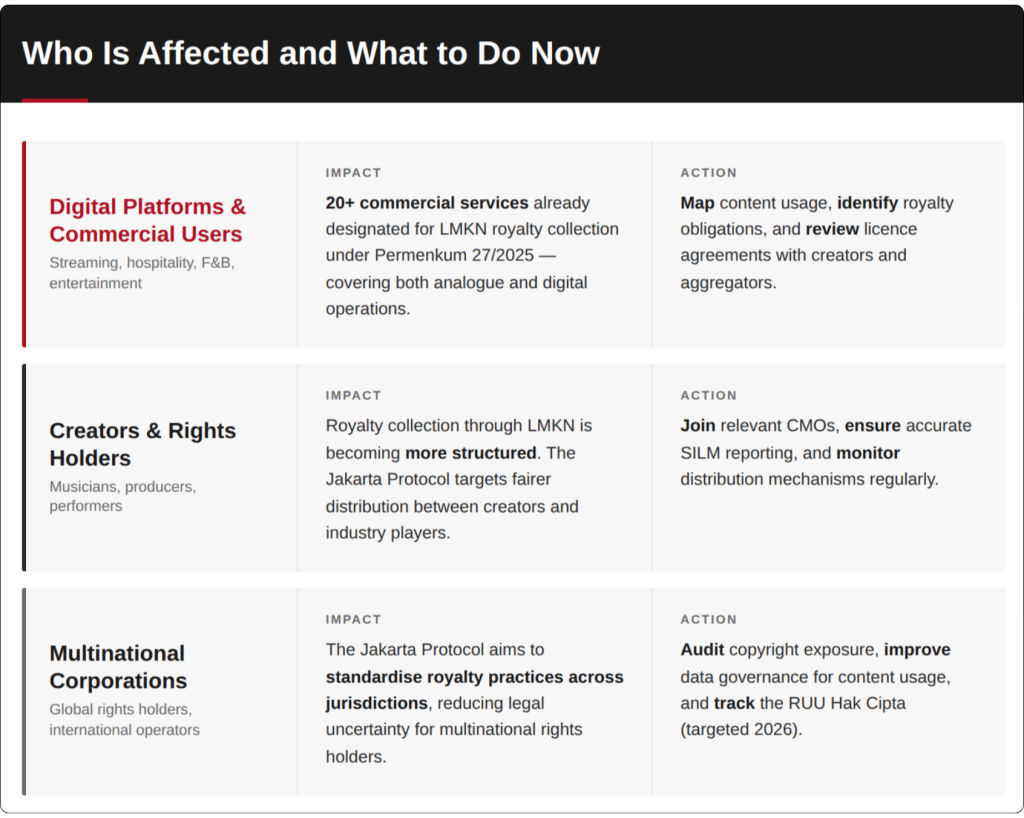
Minister of Law Regulation No. 27/2025 (Permenkum 27/2025) implements PP 56/2021, detailing mechanisms for royalty collection, aggregation, and distribution. Importantly, this regulation designates more than 20 commercial public services, both analogue and digital, as subject to royalty collection by LMKN, including accommodation facilities, food and beverage establishments, entertainment and tourism venues, and audio/video streaming services.
Implications for Rights Holders and Platforms
The integration of the Jakarta Protocol into domestic law signals a shift toward a more structured and enforceable IP environment in Indonesia. Key implications could include:
For Digital Platforms and Commercial Users:
Businesses that commercially use copyrighted content – particularly those categorised as commercial public services under Permenkum 27/2025 – may wish to begin reviewing their current practices. This could include mapping the use of audiovisual and digital music content, and complying with applicable royalty payment mechanisms under Indonesia’s royalty management framework administered through LMKN.
For Creators and Rights Holders:
Creators may consider joining relevant LMKs and keeping track of how royalties are collected and distributed. Maintaining accurate reporting in SILM and ensuring transparency in royalty records will help support fair compensation for the commercial use of their works.
For Multinational Corporations:
The Jakarta Protocol is intended to encourage more consistent royalty practices across jurisdictions, which may help reduce uncertainty for multinational rights holders. Companies working with Indonesian creators or operating digital platforms in Indonesia may wish to keep an eye on these developments and assess potential compliance considerations.
For businesses operating in Indonesia or engaging with Indonesian creators, the Protocol signals a shift toward a more structured and enforceable IP environment.
Contact SKC Law to discuss how the Jakarta Protocol may affect your IP strategy – and how we can help you stay ahead.
- Submit a custom inquiry via our Contact Page.
- Follow us on LinkedIn for more IP updates.